幺
Character Story & Explanation
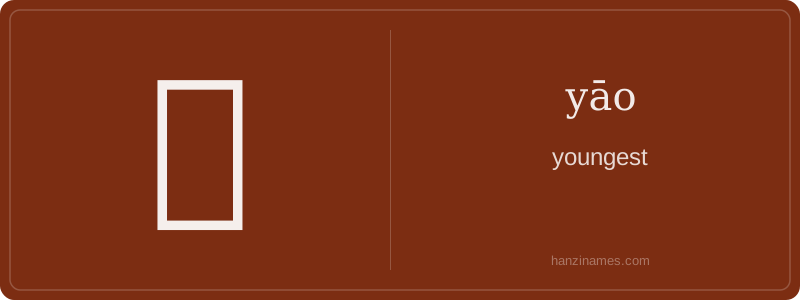
In contemporary China, 幺 appears most commonly in kinship terms like 幺妹 (yāo mèi, 'youngest sister') and 幺叔 (yāo shū, 'youngest paternal uncle'), especially in southern and central dialects and formal registers. It's also standard in military/police radio communication, where '幺' replaces the number '1' (e.g., '幺零一' for '101') to avoid confusion with '七' (qī) or '零' (líng). The term 幺二三 (yāo èr sān) is widely taught in Mandarin pronunciation drills.
The character 幺 is a simplified form of 幺 (originally 幺, variant of 幼), derived from the ancient character 幼 meaning 'young, tender'. While its earliest seal script form depicted a child with disheveled hair, the modern 幺—three strokes—evolved as a cursive, minimalist abbreviation, first standardized in the 1956 PRC character simplification list. It has no oracle bone origins; its documented usage begins in Han dynasty texts as a variant for 'youngest'.
Imagine a bustling Beijing courtyard on a crisp autumn morning—Grandma Li calls out to her youngest grandson, 'Yāo yāo, come help fold the dumpling wrappers!' Her voice carries warmth and affection. The character 幺 (yāo) embodies that tender specificity: not just 'small', but *the smallest*, *the youngest* in a sibling line. It’s a linguistic whisper of familial hierarchy, deeply embedded in Chinese kinship terms and oral tradition.
In classical texts and modern speech alike, 幺 functions as a numeral prefix meaning 'one' in formal or poetic contexts—but its most vivid, living use is as an affectionate, diminutive marker for the youngest child. Unlike generic terms like 小 (xiǎo), 幺 conveys intimacy and irreplaceable position—like calling someone 'the baby of the family' with cultural weight and tonal nuance.
This three-stroke character—two short diagonal strokes framing a tiny vertical hook—mirrors its meaning: minimal in form, maximal in relational significance. Its radical is itself, emphasizing self-contained smallness. Though rarely used alone in isolation today, 幺 thrives inside compound words and idioms, preserving an ancient lexical sensitivity to birth order that still shapes how families speak, name, and love.
Example Sentences
Common Compounds
Similar Characters — Don't Mix These Up
Your First Step into Chinese Culture: Get a Chinese Name
Every journey into Chinese begins with a name. Use our free Chinese name generator to create a meaningful, personalized Chinese name that fits you perfectly.
Get My Chinese Name →