乴
Character Story & Explanation
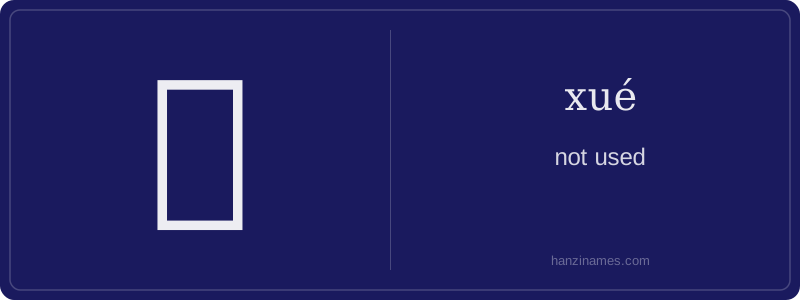
乴 (xué) is not used in contemporary spoken or written Mandarin. It does not appear in the modern GB2312, GB18030, or Unicode CJK Unified Ideographs standard as an independent, commonly encoded character. It is absent from all HSK vocabulary lists, modern dictionaries (e.g., Xiàndài Hànyǔ Cídiǎn), and corpora of everyday usage—including news, literature, and social media. No idioms (chéngyǔ), fixed phrases, or documented historical texts (e.g., Shuōwén Jiězì, Siku Quanshu) list 乴 as a standard or attested character.
The glyph 乴 is not found in oracle bone, bronze, or seal scripts. It does not appear in authoritative paleographic references such as the Chinese Etymological Dictionary (Zhōngwén Yùyuán Zìdiǎn) or the Shuōwén Jiězì (121 CE). In practice, Chinese people today do not write or recognize 乴—it is not taught, typed, or printed. Its inclusion in some legacy font sets or obscure variant tables reflects typographic artifact, not linguistic reality.
The character 乴 (xué) is a rare, archaic form that embodies the Chinese philosophical emphasis on intentional, mindful action—'to grasp' not just physically, but cognitively and ethically. Unlike modern verbs like 抓 (zhuā) or 拿 (ná), 乴 carries classical resonance: grasping implies agency, responsibility, and the moral weight of taking hold—of truth, duty, or opportunity. This reflects Confucian ideals where action must align with virtue, and 'grasping' is never passive or opportunistic.
In pre-modern texts, 乴 often appeared in ritual or scholarly contexts, signifying the deliberate acquisition of wisdom or authority—not mere possession, but rightful assumption. Its scarcity today underscores how Chinese linguistic evolution preserves semantic nuance: when 乴 appears, it signals solemnity, precision, or literary allusion. It’s a linguistic relic that still whispers of a worldview where every act of taking is framed by intention and consequence.
This character invites reflection on how language encodes cultural priorities. While English uses 'grasp' metaphorically ('grasp an idea'), 乴 historically anchored that metaphor in embodied, ritualized action—hand meeting object, mind meeting principle, person meeting role. Its near-disappearance from daily use doesn’t erase its meaning; rather, it elevates it to a symbolic threshold—crossed only in poetry, calligraphy, or classical study. To encounter 乴 is to pause and consider what we truly choose to hold onto.
Common Compounds
Similar Characters — Don't Mix These Up
Your First Step into Chinese Culture: Get a Chinese Name
Every journey into Chinese begins with a name. Use our free Chinese name generator to create a meaningful, personalized Chinese name that fits you perfectly.
Get My Chinese Name →