乸
Character Story & Explanation
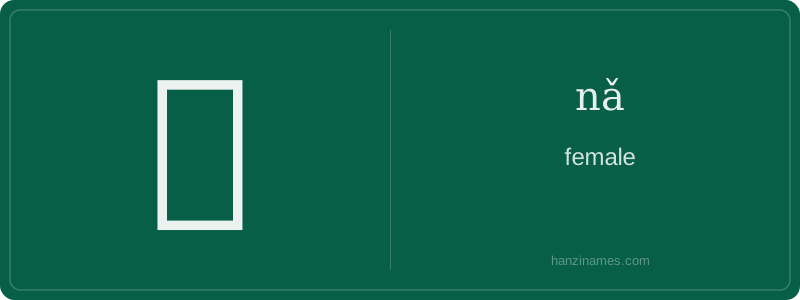
乸 is used almost exclusively in written Cantonese — especially in Hong Kong, Macau, and overseas Cantonese communities — to mark feminine animacy. It appears in compound nouns like 雞乸 (gāi nǎ, 'hen'), 狗乸 (gáu nǎ, 'bitch'), and most commonly, 豬乸 (jū nǎ, 'sow'). It does not appear in formal Mandarin texts, HSK exams, or mainland educational materials. Historically, it emerged in vernacular Cantonese writing from the late 19th century onward, documented in early Hong Kong newspapers and folk literature as a phonetic-semantic compound: the radical ⺅ (‘female’) + the phonetic component 也 (yě, though pronounced nǎ — a dialectal sound shift).
The character’s form is not pictographic; it’s a phono-semantic compound. The left-side ⺅ (nǚ bù, ‘female radical’) signals semantic category, while the right-side 也 was repurposed for its Cantonese pronunciation /nǎ/ — a common adaptation in southern Chinese characters. No oracle bone or seal script form exists; it’s a later regional creation, first standardized in Hong Kong’s 1999 Chinese Language Syllabus and included in the Hong Kong Supplementary Character Set (HKSCS).
The character 乸 (nǎ) is a linguistic artifact of Cantonese grammar and worldview — not a standard Mandarin character, but a vital marker of gendered specificity in Southern Chinese speech. Unlike Mandarin’s reliance on context or separate words like ‘female’ (雌, fēi) or ‘woman’ (女, nǚ), Cantonese uses 乸 as a bound morpheme attached to nouns to denote the female counterpart: ‘pig’ (豬, jū) becomes ‘sow’ (豬乸, jū nǎ). This reflects a pragmatic, relational view of identity — gender isn’t abstract or standalone, but embedded in kinship, function, and ecology.
Its existence reveals how language encodes cultural priorities: in agrarian Guangdong and Hong Kong, distinguishing breeding sows from boars mattered for husbandry, trade, and daily survival. The suffix doesn’t carry moral judgment or hierarchy — it’s descriptive, neutral, and functional, mirroring Confucian-influenced respect for roles within natural and social orders. There’s no ‘male’ counterpart suffix (like *乸* for male); instead, the unmarked form often defaults to male or generic — subtly affirming that femaleness requires explicit naming, a pattern seen cross-linguistically but here grounded in lived rural practice.
This character also embodies linguistic resilience. Though excluded from mainland China’s standardized character sets (GB2312, Unicode CJK Unified) until 2005 (added in Unicode 4.1), 乸 thrives in Hong Kong’s written Cantonese, signage, comics, and digital communication. Its persistence signals community agency — a refusal to erase local grammar under national standardization. To learn 乸 is to recognize that Chinese language isn’t monolithic; it’s a mosaic of regional logics, where meaning lives not just in dictionaries, but in pigstalls, wet markets, and WhatsApp messages among aunties in Sham Shui Po.
Example Sentences
Common Compounds
Similar Characters — Don't Mix These Up
Your First Step into Chinese Culture: Get a Chinese Name
Every journey into Chinese begins with a name. Use our free Chinese name generator to create a meaningful, personalized Chinese name that fits you perfectly.
Get My Chinese Name →