亍
Character Story & Explanation
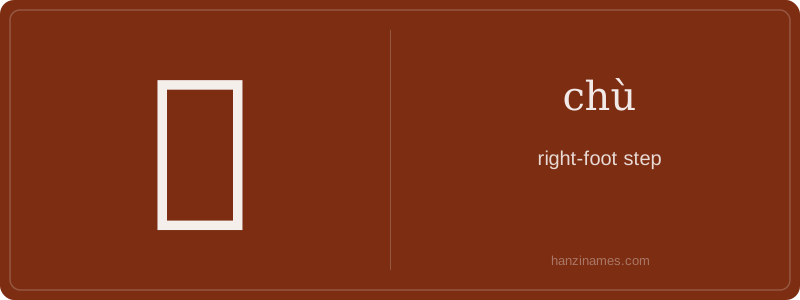
In modern Chinese, 亍 appears almost exclusively in the fixed literary phrase 彳亍 (chì chù), meaning 'to pace back and forth' or 'to walk hesitantly'. It’s found in formal writing, poetry, and historical narratives—not daily speech. The phrase appears in Lu Xun’s 1925 essay 'The True Story of Ah Q', describing a character’s anxious pacing, and in classical poetry like Li Bai’s lines referencing solitary wandering. It remains in contemporary dictionaries (e.g., Xiandai Hanyu Cidian) as a high-register, stylistic variant of 徘徊 (páihuái).
Visually, 亍 is a simplified derivative of the ancient character for 'step'—originally a pictograph of a foot (), later abstracted. Its current form (two horizontal strokes over a vertical stroke) evolved from seal script variants denoting directional foot movement. Though not a pictograph itself today, its structure reflects its role as the 'right-foot' component paired with 亍 ('left-foot') in 彳亍.
The character 亍 (chù) is a rare, archaic character meaning 'to step with the right foot'. It appears almost exclusively in the classical compound 彳亍 (chì chù), which together means 'to walk slowly or hesitantly', evoking the image of someone pausing, stepping carefully, or pacing back and forth—like a scholar pondering under a moonlit courtyard or a poet strolling thoughtfully through Suzhou’s narrow alleyways.
Though seldom used independently today, 亍 survives as a vital half of this poetic binomial. Its minimalist form—just three strokes—mirrors its function: economical, precise, and rhythmically paired. In classical Chinese prosody, 亍 provides tonal and semantic balance to 亍’s counterpart 亍, forming a yin-yang-like duality of left-right foot movement, embodying measured, mindful motion rather than mere locomotion.
This character exemplifies how even obsolete glyphs retain cultural resonance. Modern learners rarely encounter 亍 outside idioms or calligraphy practice, yet its presence in literary texts—from Tang dynasty poetry to Lu Xun’s essays—underscores how deeply embodied language is in Chinese tradition: walking isn’t just movement; it’s contemplation, hesitation, or quiet resolve made visible in stroke and sound.
Example Sentences
Common Compounds
Similar Characters — Don't Mix These Up
Your First Step into Chinese Culture: Get a Chinese Name
Every journey into Chinese begins with a name. Use our free Chinese name generator to create a meaningful, personalized Chinese name that fits you perfectly.
Get My Chinese Name →