亓
Character Story & Explanation
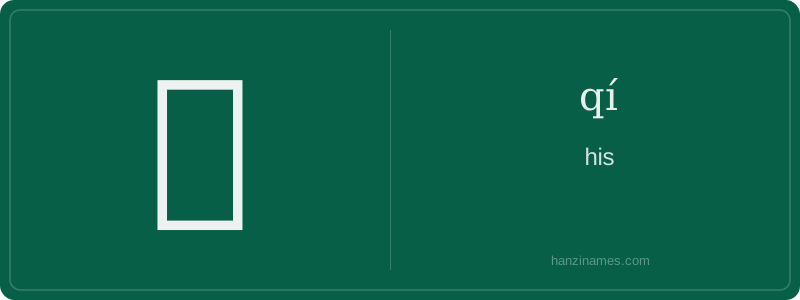
亓 is virtually unused in contemporary spoken or written Mandarin. It appears only in pre-Qin bronze inscriptions (e.g., late Western Zhou ritual vessels), Warring States bamboo slips (such as the Tsinghua collection), and occasionally in Ming–Qing genealogies where scribes adopted archaic forms for stylistic gravitas. No standard idiom, dictionary entry, or HSK wordlist includes it—it is absent from the 《现代汉语词典》 and all official language curricula.
The character’s origin is not pictographic but orthographic: it is a documented shorthand variant of 其, attested in excavated texts like the Guodian Chu Slips (c. 300 BCE). Scribes simplified 其’s complex top (a basket-like element) into two horizontal strokes (二), retaining only the core vertical structure. This reflects practical cursive adaptation—not symbolic meaning.
Our detective work begins with a startling realization: 亓 is not a common modern pronoun for 'his'—it’s a rare, archaic variant of 其 (qí), the classical Chinese possessive pronoun meaning 'his,' 'her,' 'its,' or 'their.' Unlike the standard 其, which appears over 10,000 times in pre-Qin texts like the Analects and Mencius, 亓 appears only sporadically in bronze inscriptions and early bamboo manuscripts, often as a scribal simplification or regional variant.
Linguistic forensics reveal that 亓 lacks phonetic components and isn’t listed in the Kangxi Dictionary as an independent character—it’s classified under the 二 (èr, 'two') radical purely by shape, not semantic logic. Its four-stroke form—two horizontal lines above a vertical stroke, then a final descending stroke—suggests deliberate minimalism: scribes likely omitted 其’s upper ‘jī’ (箕) component to expedite writing on bamboo slips during the Warring States period.
Modern usage is nearly extinct outside scholarly editions, genealogical records, or calligraphic art. Crucially, 亓 is *not* used in spoken Mandarin today; no native speaker says 'qí' meaning 'his' in conversation—it’s exclusively textual and literary. This makes it a linguistic fossil: preserved in dictionaries and epigraphy, but functionally dormant in living language—unlike its robust sibling 其, which remains vital in formal writing and idioms like 自食其果 (zì shí qí guǒ, 'to reap what one sows').
Example Sentences
Common Compounds
Similar Characters — Don't Mix These Up
Your First Step into Chinese Culture: Get a Chinese Name
Every journey into Chinese begins with a name. Use our free Chinese name generator to create a meaningful, personalized Chinese name that fits you perfectly.
Get My Chinese Name →