亘
Character Story & Explanation
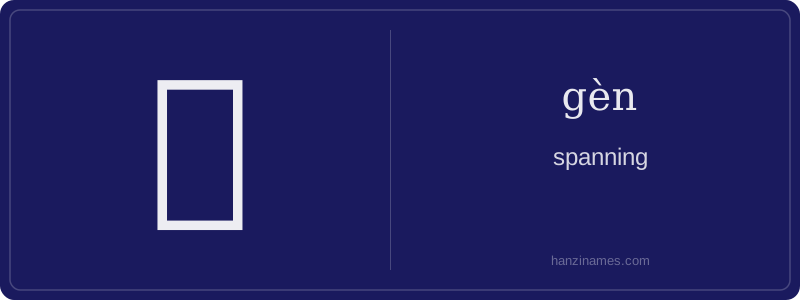
In modern Chinese, 亘 is rare in speech but potent in formal writing—especially in literature, geography, and political rhetoric. It appears in set phrases like 亘古未有 (gèn gǔ wèi yǒu, 'unprecedented since ancient times') and 亘古不变 (gèn gǔ bù biàn, 'unchanging since antiquity'), both widely attested in official media and historical texts. It’s also used in geographical descriptions: e.g., 亘于平原之上 (‘stretches across the plain’) in topographic reports.
The character’s form has no verified oracle-bone origin. Its earliest confirmed appearance is in seal script (Qin dynasty), showing two horizontal lines (radical 二) framing a central vertical stroke—symbolizing continuous span between boundaries. No pictorial source (e.g., sun/mountain) is documented; instead, it’s a conceptual glyph: pure linear continuity.
As an archaeologist brushing dust from a Han dynasty bamboo slip, I uncovered 亘—not carved as a pictograph of mountains or rivers, but as two horizontal lines bracketing a vertical stroke: a deliberate architectural gesture. This isn’t ‘long’ in duration, but *spatial continuity*—a bridge across chasms, a wall without break, a horizon uncurved by obstruction. Early scribes used it to denote unbroken span, not time’s passage—a nuance lost when glossed simply as 'eternal'.
The radical 二 (two) anchors it in duality: not opposites, but endpoints held in tension. The central stroke isn’t a pillar—it’s the *uninterrupted line connecting them*. In excavated inscriptions from the Western Han, 亘 appears in boundary markers and canal surveys, where precision mattered: ‘the dyke 亘 the floodplain’ meant *no gap, no seepage, no deviation*. It’s geometry made lexical—less poetry, more engineering.
Linguistically, 亘 resisted phonetic borrowing; its pronunciation gèn stabilized early, unlike many characters that shifted with dialects. That rigidity suggests institutional use—likely standardized by imperial surveyors or cartographers. Its rarity in oracle bone or bronze scripts confirms it emerged later, refined for administrative clarity. Today, its austerity still echoes: no flourish, no variant forms, just six strokes declaring *unbroken extension*—a silent mandate from ancient land-measurers to modern writers.
Example Sentences
Common Compounds
Similar Characters — Don't Mix These Up
Your First Step into Chinese Culture: Get a Chinese Name
Every journey into Chinese begins with a name. Use our free Chinese name generator to create a meaningful, personalized Chinese name that fits you perfectly.
Get My Chinese Name →