亢
Character Story & Explanation
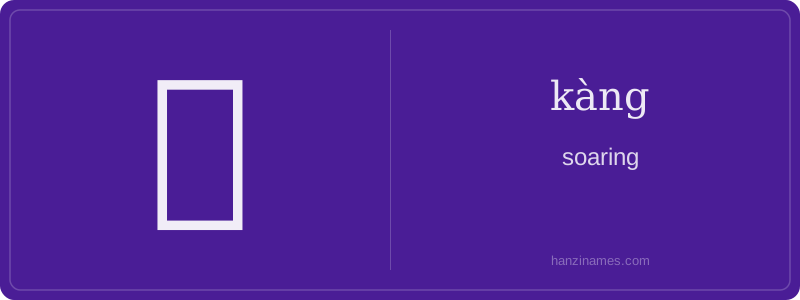
In modern usage, 亢 appears almost exclusively in classical, astronomical, or literary contexts — never in casual speech. It survives primarily in the fixed term 星亢 (xīng kàng), referring to the Kang mansion in academic astronomy texts and Daoist cosmological charts. The idiom 亢龙有悔 (kàng lóng yǒu huǐ, 'a soaring dragon regrets') from the Yì Jīng (Book of Changes, Hexagram 1) is its most famous appearance — warning against excessive pride or overextension.
The character’s form has no confirmed pictographic origin. Scholars agree it is a phono-semantic compound: 亠 signals 'upper/celestial', while 几 (jī) serves both as structural support and phonetic hint (Old Chinese *kˤrəʔ > kàng*). Today, Chinese learners encounter it mainly in classical exams, calligraphy practice, or when studying traditional astrology — rarely outside those domains.
Our detective begins at the crime scene: the earliest known inscriptions. While 亢 does not appear in verified oracle bone or bronze inscriptions, its earliest secure attestation is in Warring States bamboo texts and the Shuōwén Jiězì (121 CE), where Xu Shen classifies it under radical 亠 and defines it as 'high, elevated' — linking it to altitude and celestial prominence. Its four-stroke form suggests deliberate simplification from older, more complex variants.
Zooming in on structure: the top 亠 (a 'lid' or 'cover' radical) hints at overhead position; the lower '几' (jī, originally a low table or stand) evokes elevation — like something raised *above* a base. This compositional logic supports its core semantic field: height, excess, and celestial loftiness — perfectly fitting its role as Kang, the 14th lunar mansion, associated with the dragon’s neck and highest point in the eastern sky.
The character’s phonetic evolution is equally telling: kàng preserves the ancient *kʰaŋ* pronunciation, echoing Old Chinese roots meaning 'to rise' or 'to soar'. Unlike many constellation names derived from animal forms (e.g., 角 jiǎo 'horn'), 亢 stands out for its abstract, vertical semantics — reflecting early Chinese astronomy’s conceptualization of star groups not just as figures, but as hierarchical positions in cosmic space.
Example Sentences
Common Compounds
Similar Characters — Don't Mix These Up
Your First Step into Chinese Culture: Get a Chinese Name
Every journey into Chinese begins with a name. Use our free Chinese name generator to create a meaningful, personalized Chinese name that fits you perfectly.
Get My Chinese Name →