亥
Character Story & Explanation
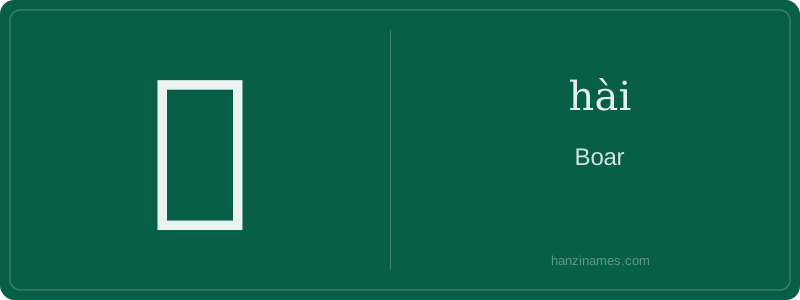
亥 appears regularly in Chinese calendars, historical documents (e.g., the Records of the Grand Historian), and modern zodiac-based media. It’s integral to the Chinese lunar calendar’s naming convention—e.g., ‘Xīn Hài’ (2019) was the Year of the Metal Boar. The character also features in idioms like 亥豕鲁鱼 (hài shǐ lǔ yú), meaning ‘textual corruption due to miswritten characters’, referencing how 亥 (boar) and 豕 (pig) were historically confused in clerical script.
The character 亥 is not pictographic but evolved from seal script forms resembling a stylized pig or boar head with curved snout and ears. Archaeological evidence from Warring States bamboo slips shows early variants with three horizontal strokes and a descending hook—consistent with its later standard form. Today, Chinese people encounter 亥 most often in zodiac forecasts, birth-year references (e.g., ‘born in the Hài year’), and classical literature citations.
亥 (hài) is the twelfth and final Earthly Branch in the traditional Chinese sexagenary cycle, representing a cyclical unit of time deeply embedded in astrology, agriculture, and historical record-keeping. It corresponds to the hours from 9–11 p.m., the tenth solar month (roughly mid-October to mid-November), and the Year of the Boar in the 12-year zodiac cycle. Unlike Western linear time concepts, 亥 reflects a holistic, rhythmic worldview where celestial movements, seasonal shifts, and human affairs are interwoven.
In Chinese cosmology, each Earthly Branch pairs with one of the Ten Heavenly Stems to form 60 unique year combinations—used for centuries in imperial chronicles, almanacs, and divination. While Western cultures mark midnight as the day’s start, 亥’s nocturnal timeframe (9–11 p.m.) aligns with the ‘first watch’ (gēng) system, emphasizing rest, introspection, and the quiet culmination of daily cycles—a philosophical contrast to the Western emphasis on dawn or noon as pivotal moments.
Culturally, 亥 resonates most visibly during the Year of the Boar—celebrated globally with red decorations, family feasts, and zodiac-themed merchandise. Yet unlike Western horoscopes based on sun signs and personality traits, 亥’s influence in Chinese tradition is contextual: it interacts with stems, yin-yang polarity, and the Five Phases (Wood, Fire, Earth, Metal, Water) to yield nuanced interpretations of fortune, health, or compatibility. This systemic complexity mirrors how Western astrology uses rising signs and aspects—not just sun signs—to refine readings.
Example Sentences
Common Compounds
Similar Characters — Don't Mix These Up
Your First Step into Chinese Culture: Get a Chinese Name
Every journey into Chinese begins with a name. Use our free Chinese name generator to create a meaningful, personalized Chinese name that fits you perfectly.
Get My Chinese Name →