亻
Character Story & Explanation
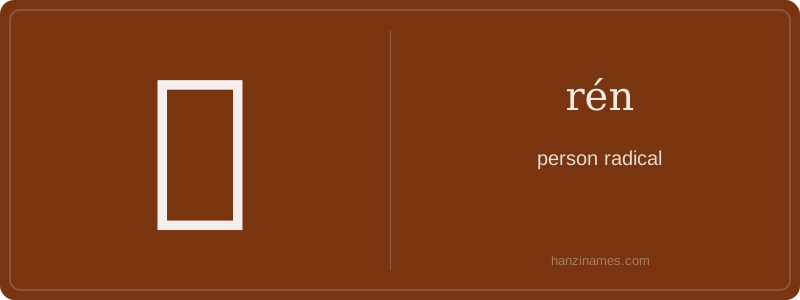
In daily life, 亻 appears in countless printed and digital contexts—from street signs ('入口 rùkǒu, entrance') to WeChat messages ('你们 nǐmen, you all'). It’s indispensable in formal writing: government documents use 伟人 (wěirén, great person), schools teach 仁爱 (rén’ài, benevolence), and news headlines feature 人民 (rénmín, people) over 100,000 times annually in Xinhua News Agency archives. Idioms like 人山人海 (rénshān-rénhǎi, 'people mountains, people seas') rely on its semantic force.
This radical originates from the ancient pictograph 人 (rén), clearly representing a side-facing human figure with bent legs in Shang dynasty oracle bone inscriptions (~1200 BCE). By the Qin dynasty seal script, it was standardized into the two-stroke left-hand form 亻—documented in authoritative sources like the Shuōwén Jiězì (100 CE), which classifies it as a 'variant form of 人 used in compound characters'.
The character 亻 is not a standalone word in modern Mandarin—it’s a radical, the 'person' or 'human' component that appears on the left side of hundreds of Chinese characters. Think of it as the DNA of human-related meaning: whenever you see 亻, the character likely involves people, actions, relationships, or social roles—like 'to help' (助), 'to wait' (待), or 'to trust' (信). It’s one of the most frequent radicals, appearing in over 700 characters in standard dictionaries.
Historically, 亻 evolved from the full character 人 (rén, 'person'), which originally depicted a standing human figure in oracle bone script. As writing became more stylized and efficient, scribes shortened 人 to its two-stroke left-side form 亻 when used as a semantic component. This simplification reflects centuries of calligraphic pragmatism—keeping meaning clear while optimizing space and speed.
For learners, recognizing 亻 is like spotting a 'people signpost' in written Chinese. It doesn’t carry pronunciation itself (it’s silent), but it signals thematic content—and often pairs with phonetic components (e.g., 在 zài, where 亻 hints at 'being present among people', and 寸 provides sound). Mastering this radical dramatically improves character recognition, especially for HSK levels 2–4 vocabulary involving social interaction, emotion, and ethics.
Example Sentences
Common Compounds
Similar Characters — Don't Mix These Up
Your First Step into Chinese Culture: Get a Chinese Name
Every journey into Chinese begins with a name. Use our free Chinese name generator to create a meaningful, personalized Chinese name that fits you perfectly.
Get My Chinese Name →