仆
Character Story & Explanation
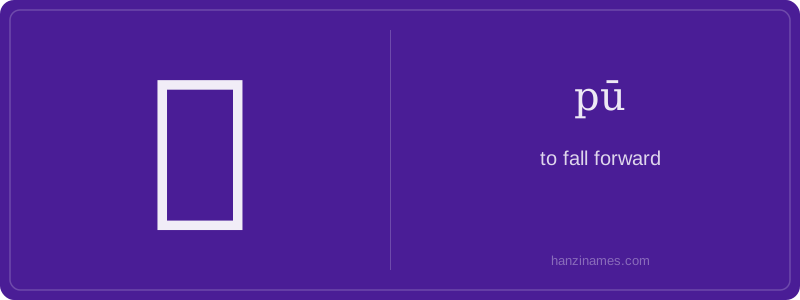
In modern Mandarin, 仆 is rarely used alone in speech—it appears almost exclusively in fixed expressions or literary registers. Its most frequent real-world use is in the idiom 仆街 (pū jiē), a Cantonese-origin phrase adopted colloquially in Mandarin internet slang meaning ‘to fail spectacularly’ or ‘to crash and burn’, evoking the visceral image of collapsing face-down onto the street. Historically, 仆 appears in classical texts like the *Zuo Zhuan* describing battlefield casualties: ‘士卒仆地’ (soldiers fell to the ground). It also survives in formal compounds like 仆从 (pú cóng, ‘attendant’) and 仆人 (pú rén, ‘servant’), retaining its pú reading.
The character’s form has no verified pictographic origin—it is not a drawing of a falling person. Instead, it emerged as a phonosemantic compound during the Warring States period. Its right-hand component 卜 was selected for sound approximation, not visual symbolism. Today, learners most commonly encounter 仆 in the verb phrase 仆倒 (pū dǎo, ‘to fall forward’)—used in news reports about accidents, sports injuries, or even AI robot malfunctions in tech journalism.
Our detective begins at the crime scene: the character 仆, written with just four strokes and bearing the radical 亻 (person). At first glance, it looks deceptively simple—two strokes for the person radical, two more for the right-hand component. But appearances deceive. The earliest attested forms in seal script (c. 3rd century BCE) show a clear structural division: 亻 + 卜 — not a random pairing, but a phonetic-semantic compound where 亻 signals human action and 卜 (bǔ) provides approximate sound. This wasn’t born from a pictograph of falling—it’s a crafted abstraction.
Zooming in on the phonetic clue: 卜 originally meant 'divination crack' (as in oracle bone cracks), but by the Warring States period, its pronunciation had drifted close enough to *pū* to serve as a phonetic anchor. No ancient text depicts someone tumbling headfirst into 卜; rather, scribes borrowed an existing character for its sound value—a common practice in Chinese character formation known as xíngshēng (phonosemantic compounding). So 仆 didn’t evolve *from* a fall—it was *assigned* the meaning ‘to fall forward’ through lexical association and classical usage.
Later, semantic expansion occurred: because servants historically knelt or prostrated themselves before masters—often lowering the body sharply forward—the same character came to mean ‘servant’ (pú), especially in formal or literary contexts. This shift isn’t metaphorical fluff—it’s documented in Han dynasty texts like the *Shuōwén Jiězì* (121 CE), which defines 仆 as ‘a person who falls (in service)’, confirming the semantic bridge between physical collapse and social submission. Thus, 仆 is a linguistic fossil preserving both motion and hierarchy in one compact glyph.
Example Sentences
Common Compounds
Similar Characters — Don't Mix These Up
Your First Step into Chinese Culture: Get a Chinese Name
Every journey into Chinese begins with a name. Use our free Chinese name generator to create a meaningful, personalized Chinese name that fits you perfectly.
Get My Chinese Name →