仕
Character Story & Explanation
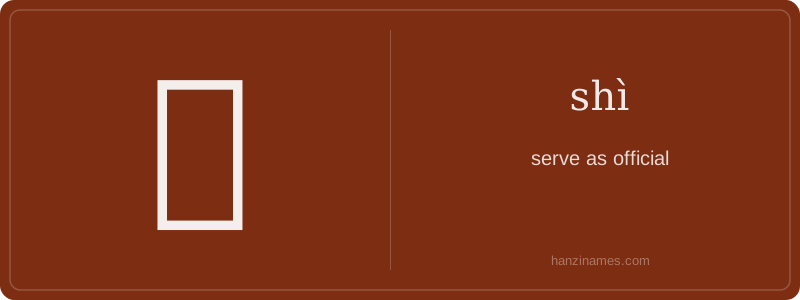
In modern Chinese usage, 仕 appears primarily in classical compounds and formal registers—not daily speech. It features prominently in idioms like 学而优则仕 (xué ér yōu zé shì), a Confucian dictum meaning 'If one excels in study, one should serve as an official.' This phrase remains widely cited in education policy debates and civil service recruitment contexts. Historically, it was central to the imperial examination system (605–1905 CE), where passing exams granted eligibility for government posts.
The character’s form is not pictographic but phono-semantic: 亻 (person radical) + 士 (shì, both phonetic and semantic component, meaning 'scholar-gentleman'). Archaeological evidence (e.g., bronze inscriptions from Western Zhou) shows 士 already denoted a warrior-scholar rank; 仕 evolved as its derivative verb form—'to serve in that capacity.' No oracle bone form survives for 仕 itself; its earliest attested use is in Warring States bamboo texts.
The character 仕 (shì) embodies the Confucian ideal of public service—rooted in the ancient Chinese scholar-official tradition where educated individuals served the state with integrity and duty. Its left-side radical 亻 (person) signals human agency, while the right side 士 (shì, 'scholar' or 'gentleman') reflects the elite class historically eligible for civil service. This fusion visually declares: 'a person who is a scholar-official.'
Though rarely used alone in modern spoken Mandarin, 仕 thrives in formal, literary, and historical contexts—especially in compound words like 官仕 (guānshì, 'official career') or 隐仕 (yǐnshì, 'retired official'). It carries gravitas, evoking imperial examinations, bureaucratic hierarchy, and moral responsibility—not mere employment, but vocation.
In contemporary China, 仕 appears most often in academic writing, historical dramas, and political commentary referencing governance traditions. Its resonance persists not as bureaucratic jargon, but as cultural shorthand for principled leadership and service ethos—echoing centuries of civil service ideals that still subtly shape expectations of public officials today.
Example Sentences
Common Compounds
Similar Characters — Don't Mix These Up
Your First Step into Chinese Culture: Get a Chinese Name
Every journey into Chinese begins with a name. Use our free Chinese name generator to create a meaningful, personalized Chinese name that fits you perfectly.
Get My Chinese Name →