仞
Character Story & Explanation
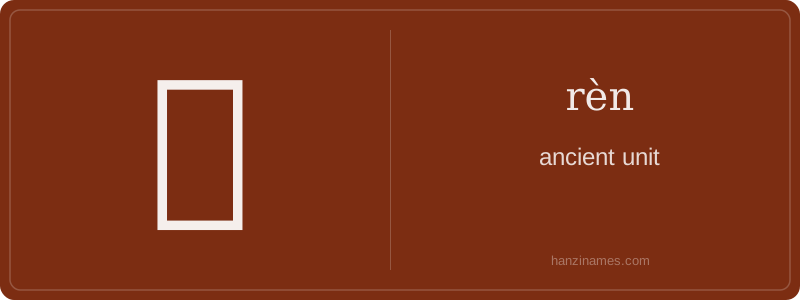
仞 is virtually unused in contemporary spoken or administrative Chinese. Its documented usage is almost entirely literary and historical: found in pre-Qin texts like the Guoyu, Han-era inscriptions, and Tang poetry—especially in idiomatic phrases describing vertical scale (e.g., mountains, cliffs, virtue). The most enduring phrase is 壁立千仞 (bì lì qiān rèn), cited in Ming-Qing commentaries and still taught in middle-school classical Chinese curricula as a metaphor for moral uprightness.
The character’s form is not pictographic—it evolved from seal script where the right component 刃 served as a phonetic loan (both 仞 and 刃 share the pronunciation rèn). No oracle bone or bronze inscription evidence exists for 仞; it first appears reliably in Warring States bamboo slips. Today, Chinese learners encounter it only when reading classical passages or calligraphy reproductions—not in daily life.
The character 仞 (rèn) is a rare but evocative unit of ancient Chinese measurement—roughly 7 to 8 chi (Chinese feet), or about 2.1–2.4 meters. Though obsolete in daily life, it survives in classical texts and literary idioms, where it conveys grandeur, scale, or insurmountable height. Its presence instantly signals antiquity and poetic weight, like measuring the heavens or a sage’s moral stature.
Visually, 仞 combines the human radical 亻 (suggesting human-scale measurement) with 刃 (rèn, 'blade edge'), likely alluding to precision or sharp demarcation—though this is phonetic borrowing, not semantic. The character’s five-stroke simplicity belies its layered historical role: it was used in Han dynasty records and Tang poetry to quantify walls, cliffs, and even ethical ideals.
In modern Mandarin, 仞 appears almost exclusively in fixed expressions like 壁立千仞 (bì lì qiān rèn)—'a cliff rising a thousand rèn'—symbolizing unyielding integrity or daunting challenge. It’s absent from HSK lists (not assigned a level), reflecting its status as a literary fossil: understood by educated readers, but never spoken in markets or classrooms. Its power lies in resonance, not utility.
Example Sentences
Common Compounds
Similar Characters — Don't Mix These Up
Your First Step into Chinese Culture: Get a Chinese Name
Every journey into Chinese begins with a name. Use our free Chinese name generator to create a meaningful, personalized Chinese name that fits you perfectly.
Get My Chinese Name →