次
Character Story & Explanation
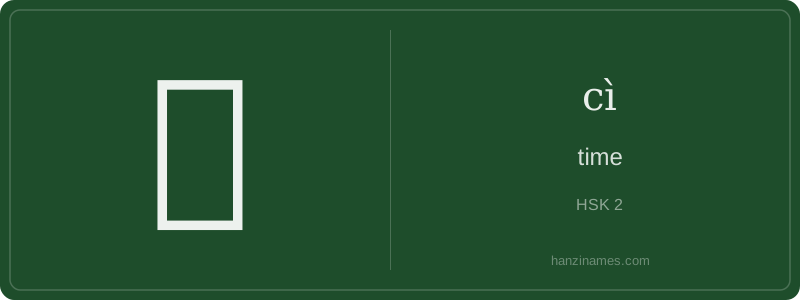
In modern China, 次 is indispensable in transportation, education, and digital interfaces. Metro announcements say ‘This train is bound for Xizhimen — next stop: Beijing Zoo’ (本次列车开往西直门,下一站:北京动物园), where 本次 (běn cì) means ‘this trip/instance’. The phrase 每次 (měi cì, ‘each time’) appears over 10 million times in Baidu news archives, and the idiom 屡次三番 (lǚ cì sān fān, ‘repeatedly, again and again’) is cited in official language reports as a high-frequency expression of persistent action.
The character’s form dates to the Warring States period bamboo slips: it combines 冫 (a variant of ice, later stylized) and 欠. Scholars (e.g., *Shuōwén Jiězì* commentary) confirm its early use for ‘order’ or ‘rank’, with no pictographic origin — unlike 日 (sun) or 木 (tree). So rather than imagining ancient symbols, picture a Shanghai subway passenger glancing at the LED display: ‘第5次列车’ — ‘Train #5’, where 次 quietly marks it as the fifth instance in the day’s schedule.
The character 次 (cì) is a foundational HSK Level 2 word meaning 'next in sequence' — not just chronological order, but rank, frequency, or occurrence. It appears constantly in daily life: bus schedules list 'next departure' as 下一次发车 (xià yī cì fāchē), and exam results show rankings like 第三名 (dì sān míng) — where 次 implicitly underlies the ordinal structure. Its simplicity (just six strokes) belies its grammatical weight: it turns numbers into ordinals and quantifies repetition.
Unlike English ‘next’, 次 never stands alone — it must follow a number or demonstrative (e.g., 第一、第二, or 这次、下次). This dependency reflects Chinese’s strict syntactic framing of sequence. Learners often overuse it like ‘time’ in English (‘I did it three times’ → 我做了三次), but misplacing it — say, before the number — breaks grammar rules instantly. Mastery means internalizing its fixed post-numeral position.
Historically, 次 appears in pre-Qin texts like the *Zuo Zhuan*, where it denotes military deployment order (e.g., ‘second campaign’: 第二次征伐). Its radical 欠 (qiàn), meaning ‘to lack’ or ‘to yawn’, hints at an older semantic link: sequence implies incompleteness — what comes ‘next’ fills the gap left by what came before. Today, this nuance survives in phrases like 次要 (cìyào, ‘secondary’), where ‘next’ conveys relative importance, not mere chronology.
Example Sentences
Common Compounds
Similar Characters — Don't Mix These Up
Your First Step into Chinese Culture: Get a Chinese Name
Every journey into Chinese begins with a name. Use our free Chinese name generator to create a meaningful, personalized Chinese name that fits you perfectly.
Get My Chinese Name →