乐
Character Story & Explanation
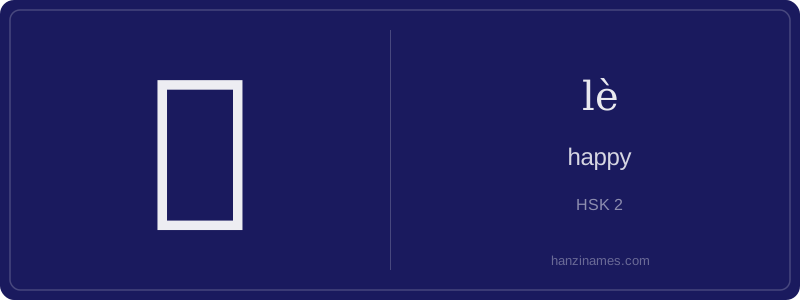
In modern Chinese, 乐 (lè) appears constantly in daily life: parents praise children with '你真乐!' (Nǐ zhēn lè! — 'You’re so cheerful!'), and social media posts often end with '开心快乐!' (kāi xīn kuài lè — 'Be happy!'). A famous idiom is 乐此不疲 (lè cǐ bù pí), meaning 'to enjoy something so much that one never tires of it' — widely used in education and work contexts. Historically, 乐 (yuè) was one of the Six Arts in Confucian education, alongside ritual, archery, and calligraphy.
The character’s earliest documented form (in bronze inscriptions, c. 1000 BCE) shows a drum with suspended bells — reflecting its original link to music (yuè). Over time, the 'joy' meaning (lè) emerged as a semantic extension: music brings happiness. No oracle-bone version survives, but Shuowen Jiezi (100 CE) classifies it under the 'wood' radical — now obsolete; today’s 丿 radical is a later simplification.
Hi students! The character 乐 (lè) is one of the most joyful words in Chinese — it means 'happy', 'cheerful', or 'to laugh'. It’s simple (only 5 strokes!) and appears early in learning — it’s an HSK Level 2 character, so you’ll see it in everyday conversations, textbooks, and even on greeting cards. Pronounced with a fourth tone (lè), it’s often used as an adjective or verb: 'I’m happy' is 我很快乐 (wǒ hěn kuài lè), and 'She laughed' can be 她乐了 (tā lè le).
But watch out — 乐 has a second, equally important pronunciation: yuè. When read this way, it means 'music' — like in 音乐 (yīn yuè, 'music') or 乐队 (yuè duì, 'band'). This dual meaning reflects an ancient Chinese idea: music and joy are deeply connected. Confucius himself praised music as essential to moral cultivation and emotional harmony.
As a beginner, start by mastering lè (happy). Write it slowly: 丿 (piě), 乀 (fú), 丶 (diǎn), 丿 (piě), 乀 (fú). Notice how the first two strokes sweep down like smiling eyes, and the last two curve like a rising mouth — it literally looks cheerful! Practice saying lè while smiling — your face and voice will both feel lighter!
Example Sentences
Common Compounds
Similar Characters — Don't Mix These Up
Your First Step into Chinese Culture: Get a Chinese Name
Every journey into Chinese begins with a name. Use our free Chinese name generator to create a meaningful, personalized Chinese name that fits you perfectly.
Get My Chinese Name →