条
Character Story & Explanation
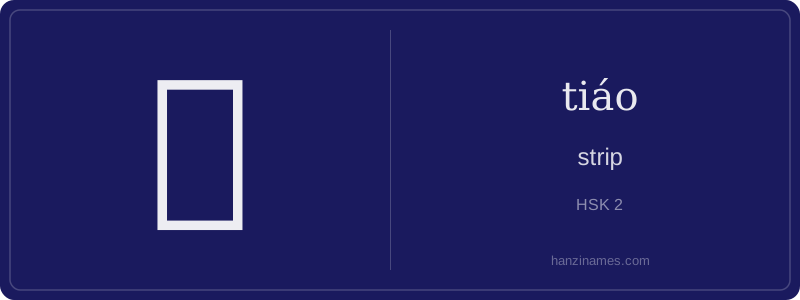
条 is indispensable in modern Mandarin as a classifier for linear, slender, or abstract sequential entities—e.g., 一条鱼 (a fish), 一条消息 (a piece of news), 一条建议 (a suggestion). It appears in foundational HSK 2 vocabulary and official documents: China’s Constitution is referred to as 宪法第一条 (Article One of the Constitution). The idiom 有条不紊 (yǒu tiáo bù wěn)—‘orderly and unhurried’—dates back to the Ming dynasty and remains widely used in business and education contexts.
Historically, 条 evolved from oracle-bone and bronze script forms depicting a tree (木) with vertical strokes, representing bamboo or wooden slips used for writing. By the Warring States period, these slips—called 简 (jiǎn)—were standardized as narrow, elongated strips bound into scrolls. Thus, 条’s radical 木 and linear stroke structure directly reflect its origin as a physical writing medium—making it one of the earliest linguistic artifacts of Chinese administrative literacy.
The character 条 (tiáo) embodies the Chinese worldview of order through measured division—transforming the boundless into the countable. As a measure word for long, narrow objects (a fish, a road, a law), it reflects a cultural preference for contextual precision over abstract universality. Unlike English ‘a’ or ‘an’, 条 assigns inherent shape and function: a ‘strip’ is not just quantity but quality—linear, continuous, and purposefully bounded.
This subtle framing reveals how language shapes perception: to say ‘one 条 law’ (一条法律) is to visualize legislation as a defined, traversable entity—not an amorphous principle, but a path with beginning and end. Even in bureaucracy or poetry, 条 implies structure that guides rather than constrains, echoing Confucian ideals where rules serve harmony, not control.
Historically, 条 emerged from wood-related imagery (radical 木), originally denoting wooden strips used for writing in pre-paper China—bamboo slips inscribed with ink. These physical strips became metaphors for clarity and record-keeping. Today, that legacy lives on: whether listing items (‘three 条 suggestions’) or drafting policies (‘five 条 regulations’), 条 quietly affirms that wisdom resides not in chaos, but in thoughtful segmentation.
Example Sentences
Common Compounds
Similar Characters — Don't Mix These Up
Your First Step into Chinese Culture: Get a Chinese Name
Every journey into Chinese begins with a name. Use our free Chinese name generator to create a meaningful, personalized Chinese name that fits you perfectly.
Get My Chinese Name →