仟
Character Story & Explanation
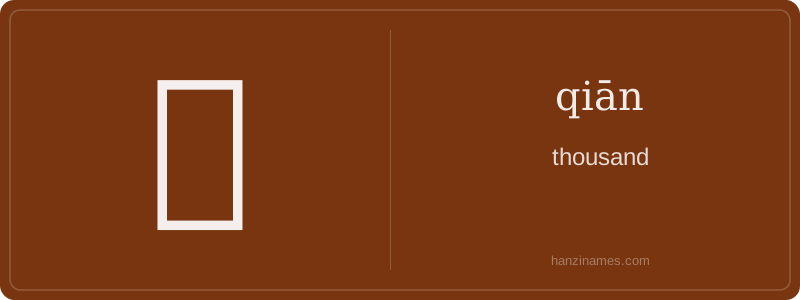
In modern China, 仟 is almost exclusively used in formal financial contexts as an ‘anti-alteration’ variant of 千 (qiān, 'thousand'). It appears on bank checks, invoices, and legal contracts — mandated by the People’s Bank of China’s standard for 'capitalized numerals' (dàxiě shùzì) to prevent fraud. Common phrases include 仟元 (qiān yuán, 'one thousand yuan') and 伍仟整 (wǔ qiān zhěng, 'exactly five thousand'). It rarely appears in speech or informal writing.
The character evolved during the Ming-Qing dynasties as part of the standardized dàxiě system. Its form combines 亻 (person radical) + 千 — not a pictograph, but a deliberate graphical expansion for clarity and security. Today, Chinese accountants, clerks, and notaries use it daily; seeing 仟 on a contract signals legal precision, not poetic flair.
Imagine walking through Shanghai’s bustling Yuyuan Bazaar on a crisp autumn morning. A vendor shouts, 'Yī qiān kuài!' — 'One thousand yuan!' — as he waves a red envelope stamped with golden 仟 characters. This isn’t just a number; it’s a cultural shorthand for substantial value, echoing centuries of Chinese accounting tradition where 仟 served as a formal, anti-fraud variant of 千 (qiān), used specifically in financial documents to prevent tampering.
The character 仟 appears on banknotes, property deeds, and wedding gift envelopes across China. Its left-side radical 亻 (‘person’) subtly signals human agency in quantifying wealth — not abstract math, but people assigning meaning to scale. Unlike casual speech (where 千 dominates), 仟 is the quiet authority in ledgers, tax forms, and official seals, lending gravitas to large sums.
Visually, its five strokes flow swiftly: a dot, a slant, then three horizontal lines — elegant yet precise. In calligraphy class at Beijing Normal University, students practice 仟 alongside other financial numerals like 壹 (yī) and 贰 (èr), mastering stroke order to avoid misreading. This character doesn’t shout — it certifies. When you see 仟, you know someone has taken care: the amount is real, the promise is binding, and tradition is still inked into daily life.
Example Sentences
Common Compounds
Similar Characters — Don't Mix These Up
Your First Step into Chinese Culture: Get a Chinese Name
Every journey into Chinese begins with a name. Use our free Chinese name generator to create a meaningful, personalized Chinese name that fits you perfectly.
Get My Chinese Name →