仡
Character Story & Explanation
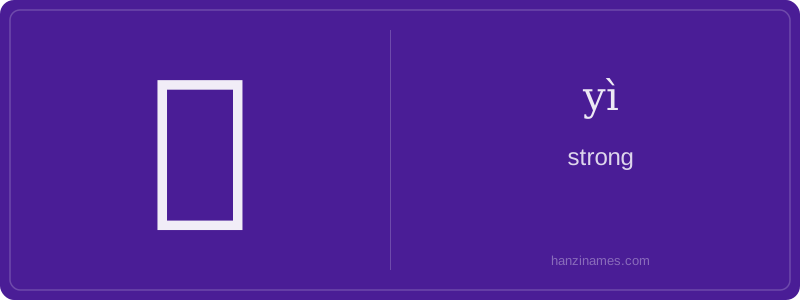
仡 is used almost exclusively in the ethnonym 仡佬族 (Gēlǎozú), one of China’s 56 officially recognized ethnic groups, primarily residing in Guizhou Province. Historical records from the Ming dynasty (e.g., Mingshi) document 'Gēlǎo' as a collective term for hill-dwelling communities; modern scholarship confirms 仡佬 language belongs to the Kra–Dai family. The character appears in no idioms, proverbs, or common adjectives—it does not mean 'strong' in everyday speech.
The character has no verified pictographic origin. Unlike ancient characters with clear visual roots (e.g., 日 for 'sun'), 仡 emerged later as a phonetic-semantic compound. Today, Chinese speakers encounter it only in official contexts: textbooks on ethnic minorities, government documents, museum exhibits, or news reports about Guizhou’s cultural heritage.
As a linguistic detective, I begin by examining the character 仡 (yì) under magnification: its left radical 亻—'person'—immediately signals human agency or qualities. The right component, 乞 (qǐ), originally meant 'to beg' but here functions phonetically, not semantically. Despite its modern dictionary definition of 'strong', this meaning isn’t derived from pictorial strength like 力 (lì, 'strength') or 勇 (yǒng, 'brave'); rather, it’s a specialized, archaic semantic extension preserved almost exclusively in ethnonyms.
Tracing historical texts, 仡 appears rarely in classical sources—no oracle bone or bronze inscriptions feature it. Its earliest verified usage emerges in Song- and Ming-dynasty gazetteers referring to the Gēlǎo people (仡佬), where 仡 serves as a phonetic loan character (假借字) for an indigenous autonym. The 'strong' gloss likely arose later as a folk etymological interpretation or descriptive gloss—not an original semantic core.
This character defies the common 'radical + phonetic' intuition: though 亻 suggests humanity, and 乞 hints at sound, neither element contributes directly to 'strength'. Instead, 仡 exemplifies how Chinese characters can fossilize sociolinguistic history—acting less as semantic building blocks and more as cultural footnotes. Its five-stroke simplicity belies deep ethnographic weight, making it less a lexical workhorse and more a quiet witness to China’s southern ethnic tapestry.
Example Sentences
Common Compounds
Similar Characters — Don't Mix These Up
Your First Step into Chinese Culture: Get a Chinese Name
Every journey into Chinese begins with a name. Use our free Chinese name generator to create a meaningful, personalized Chinese name that fits you perfectly.
Get My Chinese Name →