仨
Character Story & Explanation
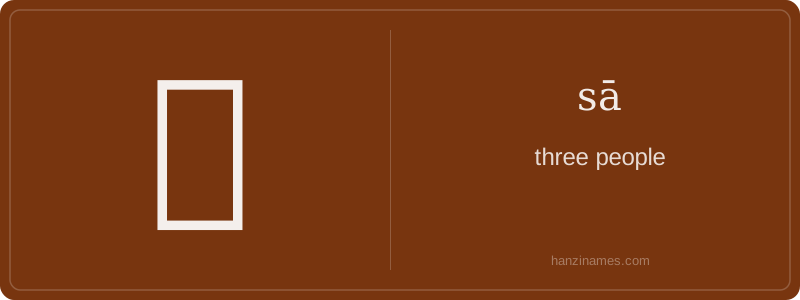
仨 is widely documented in modern vernacular literature and spoken Mandarin since at least the early 20th century, appearing frequently in works by Lao She and other Beijing-based writers to capture authentic local speech. It’s still common today in informal contexts — e.g., '咱仨去吃饭吧' ('Let’s three go eat') — but absent from formal documents, news broadcasts, or official signage. No classical or oracle-bone form exists; it’s a later linguistic innovation for colloquial efficiency.
The character is a clear phono-semantic compound: the left side 亻 indicates 'person-related', and the right side 三 provides both sound (sā, a tone-shifted variant of sān) and meaning (numerical 'three'). This structure was standardized in the 1950s during script reform and appears in authoritative dictionaries like the Xiàndài Hànyǔ Cídiǎn (Contemporary Chinese Dictionary).
Hi students! Today we’ll learn 仨 (sā), a friendly, colloquial character meaning 'three' — but not the formal one you’ll see in textbooks. Unlike the standard numeral 三 (sān), 仨 is used only when counting *people*, and only in informal spoken Mandarin, especially in northern China. It’s always attached directly to nouns without a measure word — for example, 仨人 (sā rén) means 'three people', never 'three books' or 'three apples'. Think of it as Mandarin’s shortcut for 'a trio of folks'.
This character is not part of formal writing or exams like HSK, which is why you won’t find it in beginner textbooks. But you *will* hear it constantly in movies, dramas, and daily chats — especially in Beijing or Northeastern dialects. Its tone is neutral (light, unstressed), unlike the third-tone 三 (sān), making pronunciation easier for learners. Since it’s always used with people, it subtly reinforces how Chinese grammar links numerals to categories — here, humans.
Visually, 仨 is simple: just five strokes, built from the person radical 亻 (rén bàng) on the left and the phonetic component 三 (sān) on the right. This structure tells us both meaning (related to people) and sound (sā, echoing sān). Though not an HSK character, recognizing 仨 helps you understand real speech faster — and signals you’re listening like a native, not just reading like a student!
Example Sentences
Common Compounds
Similar Characters — Don't Mix These Up
Your First Step into Chinese Culture: Get a Chinese Name
Every journey into Chinese begins with a name. Use our free Chinese name generator to create a meaningful, personalized Chinese name that fits you perfectly.
Get My Chinese Name →