伈
Character Story & Explanation
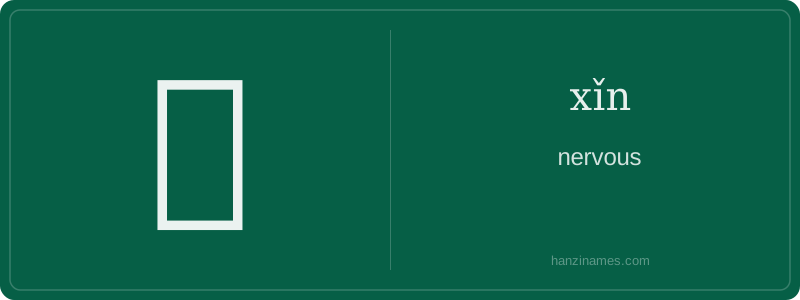
伈 is virtually unused in contemporary spoken or written Mandarin outside formal dictionaries and literary analysis. It appears almost exclusively in the reduplicated form 伈伈 (xǐnxǐn), meaning 'timidly' or 'nervously', and only in classical or highly stylized contexts—e.g., historical novels or rhetorical essays imitating classical prose. No HSK exam, textbook, or modern corpus (e.g., COCA, BCC) records its independent use. It is absent from idioms (chengyu) and has no entry in the Xiandai Hanyu Cidian (7th ed., 2016) as a standalone headword.
The character’s structure consists of two 人 (rén, 'person') radicals flanking 心 (xīn, 'heart'), suggesting 'two people observing the heart'—a metaphorical depiction of self-conscious anxiety. While this composition is documented in the Kangxi Dictionary (1716), no archaeological evidence (oracle bones, bronze inscriptions) supports earlier use. Today, if encountered at all, it’s in calligraphy demonstrations or linguistic lectures highlighting archaic emotional vocabulary.
As an archaeologist sifting through layers of linguistic sediment, I find 伈 (xǐn) not in oracle bones or bronze inscriptions—but in the quiet strata of medieval lexicography. First appearing in the 10th-century Guangyun, a rime dictionary compiling pronunciations and meanings, 伈 was classified as a rare character denoting timidity—‘heart-trembling’—its dual ‘ren’ (人) radicals framing a central ‘xin’ (心, heart), visually echoing psychological vulnerability.
This character resists Bronze Age pictographic origins; no Shāng dynasty shards bear it. Instead, it emerged from Tang–Song era philological refinement: scholars analyzing compound words like 伈伈 (xǐnxǐn) to codify nuanced emotional states. Its form is analytical—not pictorial—constructed deliberately to express inner quivering, much like how Latin ‘trepidare’ evolved into ‘trepidation’. It reflects a sophisticated pre-modern taxonomy of affect.
Unlike high-frequency characters etched on bamboo slips or steles, 伈 survives in dictionaries and classical poetry footnotes—not as a workhorse glyph, but as a lexical artifact. Its rarity signals something profound: ancient Chinese linguists reserved dedicated characters for subtle emotional textures now flattened in modern usage. To encounter 伈 is to hold a shard of pre-industrial psychology—fragile, precise, and nearly extinct in daily speech, yet preserved with scholarly reverence across millennia.
Example Sentences
Common Compounds
Similar Characters — Don't Mix These Up
Your First Step into Chinese Culture: Get a Chinese Name
Every journey into Chinese begins with a name. Use our free Chinese name generator to create a meaningful, personalized Chinese name that fits you perfectly.
Get My Chinese Name →