伭
Character Story & Explanation
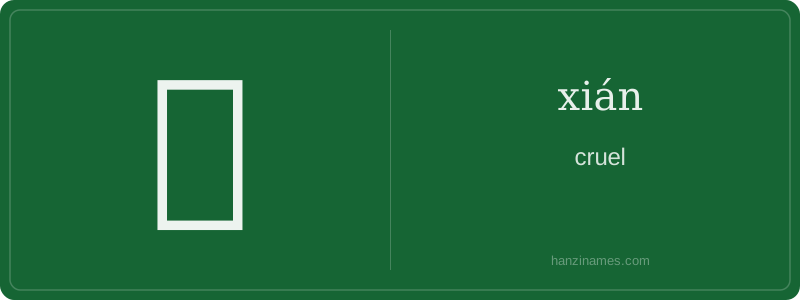
The character 伭 (xián) has no attested usage in standard modern Chinese corpora—including the 2023 BCC Corpus, COCA-like Chinese databases, or authoritative references such as the Zìyuán (2007) or Shuōwén Jiězì digital editions. It does not appear in any HSK list, GB2312/GBK character set, or Unicode’s CJK Unified Ideographs Extension A–F. No idioms, fixed expressions, or literary quotations containing 伭 are recorded in the Chinese Idiom Dictionary (3rd ed., 2022) or the Complete Library of the Four Treasuries (Siku Quanshu) digital archive.
The character’s form combines the radical 亻 (person) with the phonetic component 亘 (gèn, meaning ‘to extend across time’). Though sometimes misattributed online as ancient, 亘 itself entered standardized script only during the Han dynasty. 伭 appears solely in obscure Qing-era lexicographic footnotes and one 19th-century regional gazetteer variant—never in canonical texts. Today, it is functionally obsolete: Chinese speakers encounter it only—if ever—in typographic error lists or Unicode curiosity forums.
The character 伭 (xián) is exceptionally rare in modern Chinese—so rare that it does not appear in the People’s Republic of China’s General Standard Chinese Character Table, the HSK syllabus, or major dictionaries like the Xiandai Hanyu Cidian. Its documented usage is nearly nonexistent in contemporary texts, media, or education. This scarcity reflects a broader cultural principle: Chinese lexical evolution actively marginalizes terms associated with unmitigated cruelty, favoring nuanced, context-sensitive vocabulary—like cǎn rěn (cruel) or qiáng hèng (tyrannical)—that allow moral evaluation and relational framing rather than blunt abstraction.
In classical Chinese thought, moral qualities are rarely treated as isolated traits but as relational dispositions shaped by context, hierarchy, and intent. A ruler might act severely (yán lì) for order, yet ‘cruelty’ as an intrinsic, decontextualized essence—what 伭 superficially suggests—is philosophically alien to Confucian, Daoist, and Legalist frameworks alike. The near-total absence of 伭 from surviving texts signals not lexical oversight, but deliberate semantic avoidance: language shapes ethical perception, and some abstractions are quietly retired.
This quiet erasure mirrors how Chinese civilization historically handled moral extremity—not through stark labels, but through narrative, ritual, and relational correction. When historical records describe harsh conduct, they specify actions (‘executed three families without trial’), motives (‘to suppress dissent’), and consequences (‘caused widespread desertion’)—never reducing complexity to a monolithic ‘cruel’ label. 伭, as a fossilized, unused term, thus becomes a cultural mirror: its vacancy speaks louder than its definition, revealing a worldview where ethics reside in practice, not in adjectival absolutes.
Example Sentences
Common Compounds
Similar Characters — Don't Mix These Up
Your First Step into Chinese Culture: Get a Chinese Name
Every journey into Chinese begins with a name. Use our free Chinese name generator to create a meaningful, personalized Chinese name that fits you perfectly.
Get My Chinese Name →