伲
Character Story & Explanation
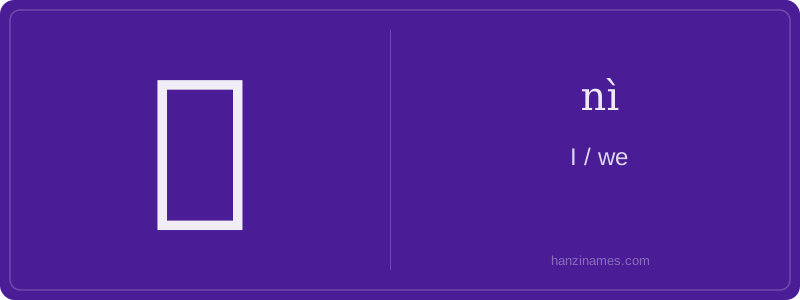
伲 (nì) is a regional first-person pronoun used primarily in Wu Chinese dialects—including Shanghainese, Suzhounese, and Ningbonese—to mean 'I' or 'we' (inclusive). It appears in colloquial speech, local media, and dialect theater, but is absent from Standard Mandarin and excluded from the HSK curriculum. No official HSK level is assigned. It is documented in authoritative sources like the *Dictionary of Wu Dialects* (2005, Shanghai Lexicographical Publishing House) and used in contemporary Shanghainese-language social media posts and subtitles for local TV dramas.
The character is a phono-semantic compound: 亻 (person radical) + 尼 (nì, phonetic). 尼 itself derives from Sanskrit 'nir' (out, away) via Buddhist transliteration, but here serves purely as a sound cue. There is no pictographic origin—its form stabilized in late imperial vernacular writing as a practical orthographic choice for a common spoken pronoun lacking a classical character.
As an archaeologist sifting through linguistic strata, I uncover 伲 not in oracle bones or bronze inscriptions—but in the living soil of Wu Chinese dialects. This character is a fossilized first-person pronoun, preserved not in classical texts but in the oral traditions of Shanghai, Suzhou, and Ningbo. Its radical 亻 (person) anchors it to human agency, while the phonetic component 尼 (nì) hints at its Sino-Tibetan resonance with self-reference across southern topolects—evidence of linguistic divergence long before Mandarin’s standardization.
Unlike standard Mandarin’s 我 (wǒ), 伲 carries sociolinguistic sediment: it signals regional identity, intimacy, and often intergenerational continuity. Fieldwork in Jiangnan villages reveals elders using 伲 to address grandchildren—not as mere ‘I’, but as ‘this elder, here beside you’. The 7-stroke form—two vertical strokes for the person radical, then five precise movements for 尼—mirrors the cultural weight packed into a single syllable: brevity masking deep relational nuance.
This character resists Han-era lexicography; it appears almost nowhere in pre-20th-century dictionaries. Its emergence in printed vernacular literature—like early Shanghai opera scripts and 1930s Wu-language newspapers—marks it as a *written accommodation* of spoken reality. To study 伲 is to excavate not ancient script, but modern linguistic resilience: a character minted not by emperors, but by grandmothers correcting pronunciation over steamed buns in Shanghainese kitchens.
Example Sentences
Common Compounds
Similar Characters — Don't Mix These Up
Your First Step into Chinese Culture: Get a Chinese Name
Every journey into Chinese begins with a name. Use our free Chinese name generator to create a meaningful, personalized Chinese name that fits you perfectly.
Get My Chinese Name →