伹
Character Story & Explanation
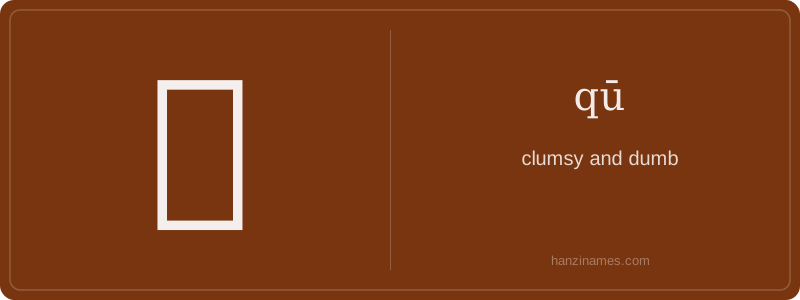
伹 does not appear in any modern Chinese textbook, corpus (e.g., CCL, BCC), or national language survey. It is absent from the 《现代汉语词典》 (7th ed.), the 《通用规范汉字表》, and all HSK wordlists. No idioms, set phrases, or documented colloquial usages containing 伹 exist in authoritative sources like the 《汉语大字典》 or 《汉语大词典》. It is not used in contemporary journalism, education, or digital communication.
The character’s form combines the person radical (亻) and the phonetic component 且 (qiě), though 且 does not reliably indicate qū—a common irregularity in ancient phonetic compounds. Since no verified oracle-bone or bronze inscription evidence exists for 伹, and no historical text cites it in context, its practical relevance today is zero. Chinese learners will never encounter it outside specialized lexicography.
The Chinese character 伹 (qū) is an extremely rare, archaic character with virtually no presence in modern Standard Mandarin usage. It appears only in historical dictionaries and classical texts, where it carries the meaning 'clumsy and dumb'—describing someone physically awkward and mentally slow. Unlike common adjectives such as 笨 (bèn) or 愚 (yú), 伹 is not taught in schools, absent from HSK lists, and unused in contemporary media, literature, or speech.
This rarity reflects how Chinese lexical evolution discards low-frequency characters when more versatile synonyms dominate. While 伹 technically belongs to the 'person' radical (亻), its structure (亻+且) offers no phonetic or semantic transparency to learners. Its pronunciation qū is irregular and non-intuitive—unlike most phonetic compounds where the right component hints at sound. Even native speakers would likely misread it without dictionary support.
In Western cultural terms, 伹 loosely parallels archaic English words like 'doltish' or 'loutish', which similarly combine physical ineptitude and intellectual dullness—but these, too, are literary relics. Unlike German 'tölpelhaft' or French 'maladroit', 伹 lacks any idiomatic or compound life in Chinese. Its significance lies not in utility but as a lexical fossil: a reminder that language preserves obsolete meanings long after they vanish from daily use.
Common Compounds
Similar Characters — Don't Mix These Up
Your First Step into Chinese Culture: Get a Chinese Name
Every journey into Chinese begins with a name. Use our free Chinese name generator to create a meaningful, personalized Chinese name that fits you perfectly.
Get My Chinese Name →