伻
Character Story & Explanation
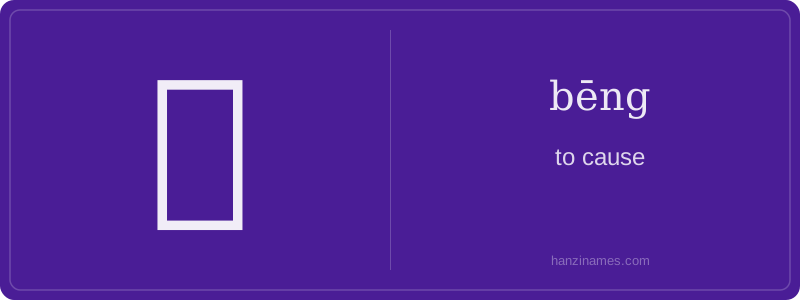
伻 appears exclusively in classical Chinese texts, most notably in the *Shàngshū* (Book of Documents), specifically the ‘Kānggào’ chapter, where King Cheng ‘causes’ (伻) his uncle to deliver a mandate—highlighting its use for authoritative delegation. It is absent from modern spoken Mandarin, contemporary dictionaries (e.g., Xiàndài Hànyǔ Cídiǎn), and all HSK vocabulary lists. No idioms or common phrases contain 伻 today; it survives only in scholarly editions and historical grammar studies.
The character is a phono-semantic compound: the ‘rén’ (人) radical on the left signals human agency, while the right component ‘bēng’ (崩) originally meant ‘to collapse’ but here serves phonetically. It is not pictographic nor attested in oracle bone inscriptions. In practice, modern Chinese speakers replace 伻 with verbs like ‘pài’ (派, to send), ‘shǐ’ (使, to cause/make), or ‘lìng’ (令, to order)—never using 伻 in daily life.
The character 伻 (bēng) is a rare, archaic verb meaning 'to cause' or 'to send forth'—not in the physical sense of dispatching a person, but as an intentional, authoritative instigation: to set something in motion through deliberate will. Its usage reflects a classical Chinese worldview where causality is inseparable from agency and moral responsibility; to 'cause' is not passive effect but conscious, often hierarchical, initiation—echoing Confucian ideals of purposeful action by those in authority.
In pre-modern texts, 伻 appears almost exclusively in formal, ritual, or bureaucratic contexts—such as royal edicts or ancestral instructions—where language itself carries performative weight. This aligns with the Chinese philosophical view that words (yán 言) are not mere descriptors but *shí* (實, 'substantial acts') capable of shaping reality. To utter 伻 was thus to enact causation linguistically, binding speech, intent, and consequence into one ethical act.
Though nearly extinct in modern spoken Mandarin, 伻 endures in literary study and historical linguistics as a linguistic fossil revealing how early Chinese conceptualized agency—not as abstract force, but as socially embedded, morally charged initiation. Its rarity today underscores a cultural shift: from a cosmos governed by deliberate, hierarchical causation toward one understood through systemic, relational dynamics (e.g., yīn-yáng interplay). Yet its presence in classics like the *Book of Documents* reminds learners that 'causing' in Chinese thought was never neutral—it was always accountable, intentional, and deeply contextual.
Example Sentences
Common Compounds
Similar Characters — Don't Mix These Up
Your First Step into Chinese Culture: Get a Chinese Name
Every journey into Chinese begins with a name. Use our free Chinese name generator to create a meaningful, personalized Chinese name that fits you perfectly.
Get My Chinese Name →