佐
Character Story & Explanation
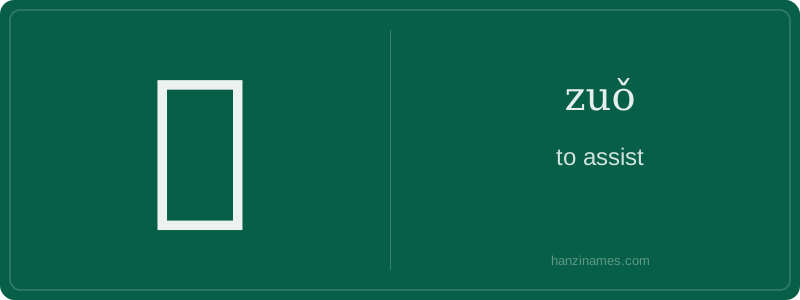
佐 appears in many official and historical Chinese terms. It’s used in the title 佐领 (zuǒlǐng), a Qing dynasty administrative/military unit leader — a real documented role in imperial bureaucracy. Today, it’s common in formal compounds like 协助 (xiézhù) and 辅佐 (fǔzuǒ), both meaning 'to assist' — the latter appears in classical texts and modern political discourse (e.g., '辅佐领导' — 'assist the leadership'). It’s also in the idiom 佐饔得尝 (zuǒ yōng dé cháng), from the Han dynasty text *Huainanzi*, meaning 'one who helps prepare the meal gets to taste it' — symbolizing shared reward for assistance.
The character evolved from seal script, where 佐 clearly combined 亻 (person) and 左 (left). Unlike pictographs like 日 (sun) or 木 (tree), 佐 is a later semantic-phonetic compound — no oracle bone form exists. Its structure reflects its function: a person (亻) acting in support, using 'left' (左) for sound — historically, 'left' was associated with secondary or supportive roles in Chinese cosmology (e.g., left ministers assisted right ministers in court).
Hi students! Let’s learn 佐 (zuǒ), a useful character meaning 'to assist' or 'to help'. It’s written with just 7 strokes and belongs to the 亻 (person) radical — telling us it relates to people and their actions. You’ll often see it in formal or official contexts, like job titles (e.g., 副手 zuǒshǒu — 'assistant') or historical terms. Though not among the most common daily-use characters, it appears frequently in written Chinese, especially in news, government documents, and academic texts.
Don’t confuse 佐 with similar-looking characters — its left side is always the person radical 亻, not the water radical 氵 or the speech radical 讠. The right side is 左 (zuǒ), meaning 'left', which also gives this character its pronunciation. This is a classic example of a phono-semantic compound: the right part hints at sound, the left part hints at meaning (a person helping).
As a beginner, focus on recognizing 佐 in compound words rather than using it alone. Native speakers rarely say just 'zuǒ' by itself — it’s almost always part of a two-character word. Practice writing it slowly: start with the person radical (two strokes), then write 左 carefully — remember the horizontal stroke comes before the vertical one in the top-left corner. Repetition builds muscle memory!
Example Sentences
Common Compounds
Similar Characters — Don't Mix These Up
Your First Step into Chinese Culture: Get a Chinese Name
Every journey into Chinese begins with a name. Use our free Chinese name generator to create a meaningful, personalized Chinese name that fits you perfectly.
Get My Chinese Name →