佞
Character Story & Explanation
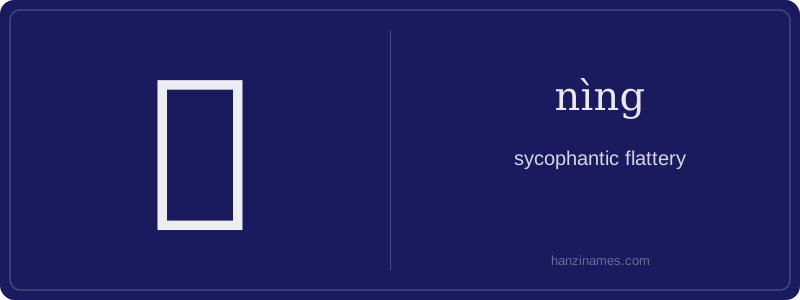
In classical Chinese history, 佞 was frequently used in official histories like the Records of the Grand Historian (Shǐjì) to condemn courtiers who flattered tyrannical rulers—e.g., eunuchs or ministers who undermined loyal ministers through deceitful praise. Today, it survives mainly in fixed idioms and formal writing: 佞臣 (nìngchén, 'sycophantic minister') appears in textbooks and historical dramas; 佞口 (nìngkǒu, 'flattering tongue') is found in literary criticism. Modern media may use it ironically in editorials criticizing politicians who ‘bend truth for approval’.
The character’s form is not pictographic. Its right component 壬 (réng) is a phonetic loan—it doesn’t depict flattery but approximates the sound. No oracle bone or bronze script form of 佞 exists; it first appeared in Warring States bamboo texts as a phonosemantic compound: 亻 (person) + 壬 (sound). So rather than imagining ancient pictures, think of real usage: a journalist writing ‘他以佞言取宠’ (He won favor with flattering words) to critique performative loyalty in politics.
Hi students! Let’s learn 佞 (nìng), a character that describes insincere, self-serving flattery—especially when someone praises a person in power just to gain favor. It’s not just ‘being polite’; it carries strong negative connotations, like sycophancy or manipulation. The radical 亻 (person) tells us it’s about human behavior, and the right side (壬, rén) originally represented a pillar or support—but here, it’s purely phonetic, helping with pronunciation.
This character is rarely used alone in modern speech. Instead, it appears in formal, literary, or historical contexts—often in criticism of corrupt officials or courtiers who deceived emperors with smooth talk. Think of it as the ‘flattery that hides an agenda’. Because it’s morally charged, native speakers use it carefully, usually in writing or serious discussion—not casual chat.
While beginners won’t encounter 佞 daily, understanding it deepens your grasp of Chinese values: sincerity (诚, chéng), integrity (正直, zhèngzhí), and the Confucian warning against ‘smooth talkers’ (巧言令色, qiǎoyán lìngsè). It’s a great example of how Chinese characters encode ethical judgment—not just action, but *intent*. Mastering such words helps you read classical texts, news commentary, and even political satire with greater nuance.
Example Sentences
Common Compounds
Similar Characters — Don't Mix These Up
Your First Step into Chinese Culture: Get a Chinese Name
Every journey into Chinese begins with a name. Use our free Chinese name generator to create a meaningful, personalized Chinese name that fits you perfectly.
Get My Chinese Name →