佰
Character Story & Explanation
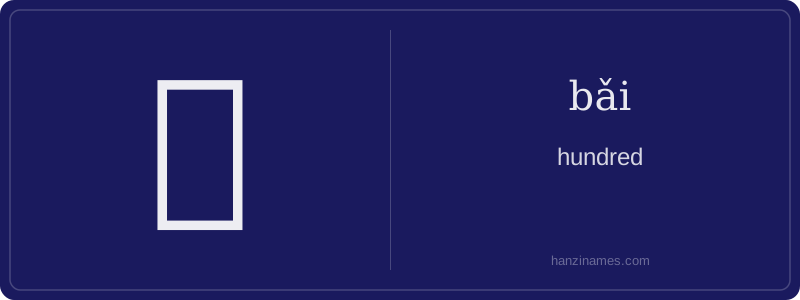
In modern Chinese, 佰 is almost exclusively used in formal written contexts—especially financial documents, legal contracts, and ceremonial inscriptions—to prevent tampering. For example, bank checks and promissory notes require 佰 instead of 百 to avoid fraudulent alteration (e.g., adding strokes to change 百 into 千). This practice is codified in China’s Regulations on Standardized Writing for Financial Instruments (2003), mandating 佰 for ‘hundred’ in monetary amounts.
The character is a phono-semantic compound: 亻 (person radical, indicating human-scale quantity) + 白 (bái, phonetic component suggesting pronunciation). While 白 itself means ‘white’, its sound approximates bǎi here. No oracle-bone or bronze script form of 佰 exists—it emerged later, during the Han dynasty, as a variant for clarity in administrative writing. Today, Chinese people encounter it most often on official receipts, wedding gift envelopes (where cash amounts are written formally), and stone inscriptions at historic sites.
Imagine walking through a bustling Beijing antique market on a crisp autumn morning. A vendor proudly displays hand-painted porcelain bowls—each marked with delicate red characters. One bowl bears the inscription ‘佰福临门’ (bǎi fú lín mén), meaning ‘a hundred blessings enter the door.’ Here, 佰 isn’t just a number—it’s a cultural amplifier, multiplying auspiciousness. As shoppers pause to admire the craftsmanship, they instinctively recognize 佰 as the formal, elegant variant of ‘hundred,’ often chosen for ceremonial or decorative contexts over the more common 百.
This character appears frequently in financial and commemorative settings: banknotes (especially older 100-yuan notes), temple donation boxes labeled ‘佰元善款’, and engraved bronze plaques marking centennial anniversaries. Its presence signals gravitas and tradition. Unlike 百, which dominates everyday speech and math, 佰 carries a subtle classical weight—like using ‘century’ instead of ‘100 years’ in a formal speech.
Visually, 佰 stands out with its 亻 (person) radical—a clue to its historical function: originally denoting ‘one hundred people’ in ancient military or census records. Though now fully numeric, that human element remains embedded in its form. Learners often confuse it with 百, but the extra stroke (the vertical line in 亻) anchors it in formality. In calligraphy classes across Hangzhou and Xi’an, students practice 佰 to master balance between radical and phonetic component (白), reinforcing both structure and symbolism.
Example Sentences
Common Compounds
Similar Characters — Don't Mix These Up
Your First Step into Chinese Culture: Get a Chinese Name
Every journey into Chinese begins with a name. Use our free Chinese name generator to create a meaningful, personalized Chinese name that fits you perfectly.
Get My Chinese Name →