佴
Character Story & Explanation
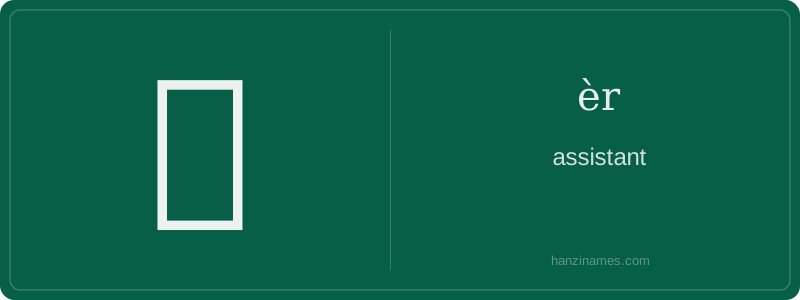
佴 is virtually unused in modern spoken or written Mandarin outside of proper nouns. It appears almost exclusively as a rare surname — historically recorded in texts like the Bai Jia Xing (Hundred Family Surnames, c. 12th century) and still borne by small communities in Jiangsu and Anhui provinces. No idioms, set phrases, or contemporary compound words containing 佴 are attested in authoritative corpora (e.g., BCC, COCA, or the Ministry of Education’s Modern Chinese Frequency Dictionary). It does not appear in any HSK vocabulary list or standard textbook.
The character’s form is not pictographic: its right side 尔 evolved from oracle bone script forms representing tassels or decorative ribbons, later phoneticized. The full character 佴 has no verified pictorial origin; it is a phono-semantic compound (亻+ 尔), with 尔 providing sound (ěr → èr via tone shift) and 亻 indicating human agency. Today, if encountered, it’s almost certainly in a name — e.g., on an ID card or academic paper — not in conversation.
Our detective begins at the crime scene: the character 佴, pronounced èr, stands out like a quiet witness in the crowded lineup of Chinese characters. With only eight strokes and the 'person' radical (亻) on the left, it signals human involvement — but not as a protagonist. Instead, it hints at someone standing beside, supporting, or assisting. Its right component, 尔 (ěr), is an ancient pronoun meaning 'you' or 'that', later repurposed phonetically. This duality — person + 'you' — subtly frames the role of an assistant: one who stands *with* another, not ahead.
Historically, 佴 never rose to prominence as a standalone verb or adjective. Unlike common assistants like 助 (zhù) or 帮 (bāng), 佴 remained niche — preserved mainly in surnames and classical administrative terms. In pre-modern legal texts, 佴 appeared in phrases like ‘佴于吏’ (to be placed under official custody), where it conveyed assignment or subordination. Its rarity suggests it was never about voluntary aid, but rather formal, hierarchical placement — a bureaucratic footnote rather than a helping hand.
Modern linguistics confirms 佴 is not a high-frequency character: absent from all six HSK levels and excluded from the 3,500 most common characters. It survives almost exclusively as a surname (e.g., 佴氏), documented in historical records like the Song-era Hundred Family Surnames. Its 'assistant' meaning is now archaic and lexicalized — more etymological residue than living usage. For learners, encountering 佴 is less about daily communication and more about deciphering textual fossils: a reminder that Chinese orthography preserves layers of social structure, even in near-silent characters.
Example Sentences
Common Compounds
Similar Characters — Don't Mix These Up
Your First Step into Chinese Culture: Get a Chinese Name
Every journey into Chinese begins with a name. Use our free Chinese name generator to create a meaningful, personalized Chinese name that fits you perfectly.
Get My Chinese Name →