佶
Character Story & Explanation
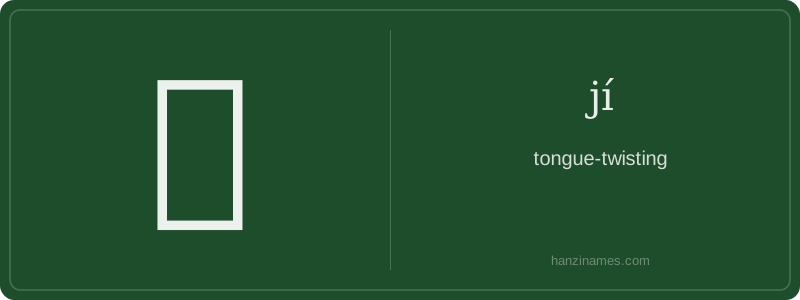
佶 is rarely used in contemporary spoken Mandarin but appears in formal linguistic writing, dictionary definitions, and stylistic critiques—especially when analyzing foreign names, technical terminology, or classical poetry with dense alliteration. It is notably absent from HSK vocabulary lists (HSK Level: Not included), confirming its specialized, non-curricular status. No major idioms or set phrases center on 佶; it most commonly occurs in compound forms like 佶屈 (jí qū) or 佶屈聱牙 (jí qū áo yá), the latter being a classical idiom meaning 'abstruse and hard to articulate', documented since the Tang–Song dynastic transition in literary criticism.
The character 佶 is a phono-semantic compound: the radical 亻 (person) signals human articulation, while the phonetic component 吉 (jí) provides sound and contributes semantic resonance—吉 means 'auspicious', suggesting an ironic contrast: what sounds auspicious may in fact be hard to say. This structure is well-documented in the *Shuōwén Jiězì* (121 CE), where 佶 is defined as 'stiff, unyielding in speech'—not invented folklore, but early lexicographic record.
The Chinese character 佶 (jí) is a relatively rare and literary term meaning 'difficult to pronounce' or 'tongue-twisting'—referring to words or names whose phonetic structure challenges articulation. Though not common in daily speech, it appears in classical and modern linguistic commentary to describe phonological complexity. Its usage reflects Chinese linguistic self-awareness: rather than labeling sounds as 'foreign' or 'weird,' scholars use 佶 to objectively denote articulatory difficulty, especially with clusters of retroflex or aspirated consonants.
Unlike English terms like 'unpronounceable'—which often carry negative or humorous connotations—佶 is neutral and technical. It appears in dictionaries and academic texts discussing phonetics, onomastics, or poetic diction. The character itself does not imply obscurity or archaism, only phonetic density; thus, a modern Mandarin speaker might call a newly coined tech brand name 佶口 (jí kǒu, 'tongue-twisting') without irony or judgment.
In Western cultural equivalents, English uses phrases like 'a mouthful' or 'a tongue twister'—but these emphasize playful difficulty (e.g., 'Peter Piper'). German has 'zungenbrecher' (literally 'tongue-breaker'), similarly playful. French 'mot difficile à prononcer' is descriptive but lacks a single lexicalized term. 佶 stands out for its concision and scholarly neutrality: one character encapsulates a precise phonetic observation, aligning with Chinese lexicographic traditions that value semantic economy and contextual precision over emotive flair.
Example Sentences
Common Compounds
Similar Characters — Don't Mix These Up
Your First Step into Chinese Culture: Get a Chinese Name
Every journey into Chinese begins with a name. Use our free Chinese name generator to create a meaningful, personalized Chinese name that fits you perfectly.
Get My Chinese Name →