佸
Character Story & Explanation
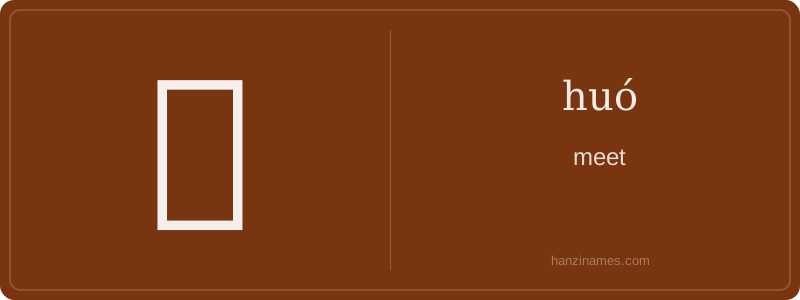
The character 佸 appears exactly once in the Shījīng (Book of Songs), in Ode 154 ‘Yǒu Wēi’ (‘There Is a Vine’), where it describes family members gathering for harvest — '佸佸' (huó huó) evokes rhythmic, harmonious reunion. This reduplicated form is its only documented classical usage. No modern idioms, dictionaries, or media use 佸 today — it’s effectively obsolete outside philological study or classical poetry recitation.
The character is a phono-semantic compound: the left radical 亻 (person) signals human action; the right component 活 (huó, 'alive, lively') provides both sound and semantic nuance — implying a vibrant, life-affirming meeting. This structure is well-documented in the Shuōwén Jiězì (121 CE), China’s earliest dictionary, confirming its classical origin and compositional logic.
Hi students! Let’s talk about the character 佸 (huó). First, it’s important to know this is a *very rare* character in modern Chinese — you won’t find it in everyday texts, apps, or HSK exams. It appears almost exclusively in classical poetry and ancient literature, especially in the Shījīng (Book of Songs), China’s oldest anthology of poetry (c. 11th–7th centuries BCE). Its meaning centers on 'to meet' or 'to gather', often with a warm, familial or communal connotation — like reuniting after separation.
Don’t confuse 佸 with more common 'meet' characters like 见 (jiàn) or 遇 (yù). 佸 carries poetic weight and emotional resonance — think of joyful reunions of kin or seasonal gatherings. Because it’s archaic, it has no simplified form and isn’t taught in standard curricula. Even native speakers may need to look it up. That said, recognizing it helps deepen appreciation of classical Chinese and literary allusions.
Its pronunciation huó is consistent — no tone changes in compounds — and it’s always used as a verb. While it looks simple, its rarity means learners should prioritize high-frequency characters first. Still, encountering 佸 in a poem is like finding a tiny cultural artifact: it reminds us how language preserves ancient human experiences — like the deep joy of coming together.
Example Sentences
Common Compounds
Similar Characters — Don't Mix These Up
Your First Step into Chinese Culture: Get a Chinese Name
Every journey into Chinese begins with a name. Use our free Chinese name generator to create a meaningful, personalized Chinese name that fits you perfectly.
Get My Chinese Name →