侀
Character Story & Explanation
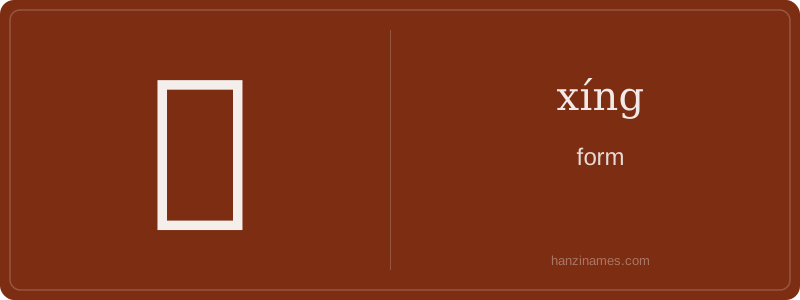
侀 is documented in bronze inscriptions from the Western Zhou dynasty (c. 1046–771 BCE) and appears in excavated bamboo texts such as the Guōdiàn Chu Slips (c. 300 BCE), where it functions identically to 形 in phrases like '有侀無氣' ('has form but no vital energy'). It was gradually replaced by 形 during the Qin-Han standardization of script. No modern idiom or common phrase uses 侀; its presence today is confined to academic paleography and critical editions of pre-Qin philosophy.
The character combines 亻 (person) and 刑 (xíng, 'punishment; model'), reflecting its origin as a phonosemantic compound where 刑 provided both sound and conceptual nuance—'model' or 'standardized form'. Unlike pictographic characters (e.g., 日 'sun'), 侀 is not iconic but abstractly constructed, underscoring how early Chinese writing encoded philosophical concepts through component logic rather than visual resemblance.
The character 侀 (xíng) is an archaic, rarely used variant of 形 (xíng), meaning 'shape', 'form', or 'appearance'. It appears almost exclusively in classical texts, pre-Qin bronze inscriptions, and early philosophical writings—especially in Daoist and Legalist contexts where precise distinctions between substance and form were central. Its usage reflects a time when Chinese script was still standardizing, and variant forms coexisted regionally.
Though visually distinct—featuring the 亻 (person) radical instead of 彡 (ornament/stroke)—侀 carries the same semantic weight as 形: denoting outward manifestation versus inner essence. In ancient cosmology, 侀 often appeared alongside terms like 氣 (qì, vital energy) to contrast tangible form with intangible force—a duality foundational to Chinese medicine and martial arts theory.
Today, 侀 is virtually absent from modern education, media, and daily communication. It’s not included in the HSK syllabus, nor in the GB2312 or Unicode CJK basic set for everyday use. Learners are far more likely to encounter 形 in textbooks, signage, or compound words. Nevertheless, encountering 侀 in museum labels, scholarly editions of the Guǎnzǐ or Zhuāngzǐ, or epigraphic studies offers a rare glimpse into the fluidity of early Chinese orthography.
Example Sentences
Common Compounds
Similar Characters — Don't Mix These Up
Your First Step into Chinese Culture: Get a Chinese Name
Every journey into Chinese begins with a name. Use our free Chinese name generator to create a meaningful, personalized Chinese name that fits you perfectly.
Get My Chinese Name →