仑
Character Story & Explanation
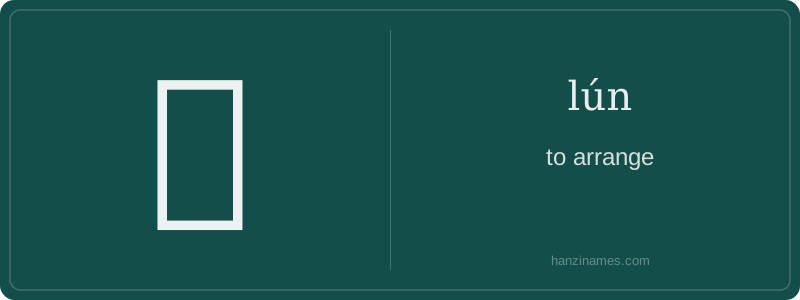
仑 is rarely used alone in modern Mandarin; it appears almost exclusively in compounds like 昆仑 (Kūnlún, referring to the mythic Kunlun Mountains—a symbol of cosmic order—and now used in names like Kunlun Bank or Kunlun Lubricants). Historically, it appears in the term 仑才 (lún cái), an archaic phrase meaning 'to select and arrange talent', found in Tang-dynasty administrative documents. The most widespread contemporary use is in 圆仑 (yuánlún) — though rare—more commonly seen in the standardized term 仑 (as part of 崇仑, a historical variant for mountainous order).
The character’s origin is not pictographic but phonosemantic: the 人 radical hints at human agency, while the right component 仑 originally derived from 轮 (lún, 'wheel'), sharing pronunciation and connoting cyclical, orderly motion. Though simplified, its structure retains this conceptual link to regulated movement and systematic placement.
The character 仑 (lún) embodies a quiet yet profound aspect of the Chinese worldview: order as relational harmony, not rigid control. Its radical 人 (rén, 'person') signals that arrangement is inherently human-centered—done *by* people, *for* people, and *among* people. In classical thought, arranging isn’t about imposing hierarchy but aligning roles, resources, and timing to sustain balance—echoing Confucian ideals of proper conduct and Daoist reverence for natural patterning.
Though only four strokes, 仑 carries weight beyond its simplicity. It appears almost exclusively in compound words—not as a standalone verb—reflecting a cultural tendency to express abstract actions through contextualized, relational terms. This mirrors how Chinese philosophy often avoids isolated absolutes; meaning emerges from position, relationship, and usage, not definition in isolation.
This subtle character reveals how Chinese language encodes ethics into grammar: to ‘arrange’ is never neutral—it implies responsibility, care, and foresight. Whether organizing texts, managing logistics, or structuring a ritual, 仑 evokes intentionality rooted in communal well-being. Its minimal form thus becomes a vessel for maximal cultural meaning: order as an act of virtue, not just efficiency.
Example Sentences
Common Compounds
Similar Characters — Don't Mix These Up
Your First Step into Chinese Culture: Get a Chinese Name
Every journey into Chinese begins with a name. Use our free Chinese name generator to create a meaningful, personalized Chinese name that fits you perfectly.
Get My Chinese Name →