侗
Character Story & Explanation
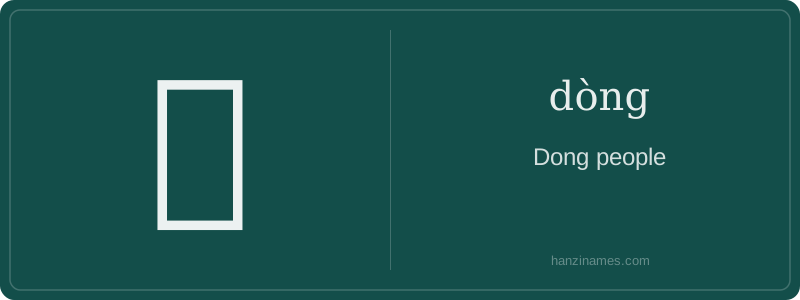
侗 is used almost exclusively in reference to the Dong ethnic group — especially in official contexts like the State Ethnic Affairs Commission, UNESCO documents listing Dong Grand Song as Intangible Cultural Heritage (2009), and travel guides for villages like Zhaoxing and Chengyang in Guizhou. You’ll rarely hear it in casual speech; instead, it appears in compound terms like 侗族 (Dòngzú, 'Dong nationality') or 侗寨 (Dòngzhài, 'Dong village'). No idioms feature 侗 alone — it’s strictly ethnolinguistic.
The character is a phono-semantic compound: 亻 (person radical) + 同 (tóng, phonetic component). Historical sources (e.g., *Shuōwén Jiězì* commentary, Qing dynasty) confirm 同 was borrowed for its sound, not meaning. Its earliest attested use in this sense appears in Ming–Qing local gazetteers referring to 'Dong' as a distinct southern minority — not a description of 'sameness', but a phonetic transcription of the autonym 'Kam'.
Hi students! Today we’re learning the character 侗 (dòng), which primarily refers to the Dong ethnic group — one of China’s 56 officially recognized ethnic minorities, with deep roots in Guizhou, Hunan, and Guangxi provinces. It’s a proper noun character, so you’ll almost always see it in names or cultural contexts, never as a standalone adjective or verb. Don’t confuse it with common words like ‘east’ or ‘child’ — its meaning is specific and respectful.
The character has only 8 strokes and uses the 亻(person) radical, signaling its connection to people or ethnicity. Its structure is simple: left side is the person radical (亻), right side is 同 (tóng, meaning ‘same’ or ‘together’) — visually reminding us that the Dong people share language, drum towers, grand songs (Dage), and rice-paddy culture. Though pronounced dòng here, 同 itself is tóng — a helpful memory link!
While 侗 is not in the HSK syllabus (it’s too specialized for general proficiency exams), it appears frequently in geography, anthropology, and news about ethnic policies or intangible cultural heritage. You’ll encounter it in textbooks about Chinese diversity, museum exhibits, or documentaries on Dong architecture. Learning it helps you understand how Chinese writing honors cultural identity — one character, one people, centuries of tradition.
Example Sentences
Common Compounds
Similar Characters — Don't Mix These Up
Your First Step into Chinese Culture: Get a Chinese Name
Every journey into Chinese begins with a name. Use our free Chinese name generator to create a meaningful, personalized Chinese name that fits you perfectly.
Get My Chinese Name →