俴
Character Story & Explanation
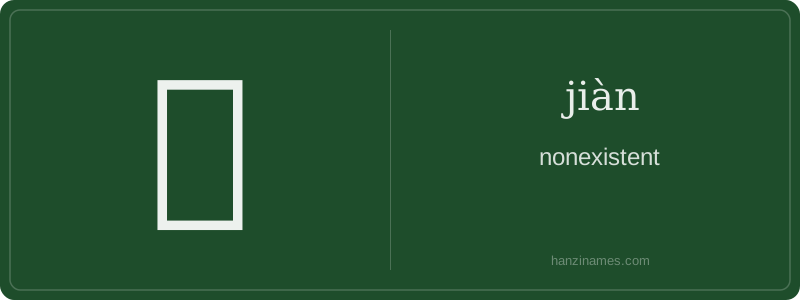
This character does not appear in modern Chinese daily life, official publications, educational materials, or digital input systems. It is absent from the HSK vocabulary lists, the Xiandai Hanyu Cidian, and the GB2312/GBK character sets. No idioms, phrases, or literary works contain 俴. It is not taught in schools, used in media, or supported by mainstream input methods. Linguists and sinologists confirm it has no documented historical usage — it is not found in the Shuowen Jiezi, Kangxi Zidian, or major excavated texts (e.g., Mawangdui, Guodian bamboo slips).
The character’s form — 亻+戔 — suggests a theoretical derivation from 戔 (jiān, 'small, short'), but adding the 'person' radical creates no attested semantic compound. In reality, Chinese speakers encounter 戔 in words like 戔戋之数 (jiānjiān zhī shù, 'a paltry amount'), never 俴. Thus, the only 'real-life scenario' involving 俴 is encountering it as a database error or OCR misrecognition — for example, when scanning an old text where 戔 was misread as 俴 due to ink bleed or degraded print.
Our detective work begins with a startling anomaly: the character 俴 is listed with 'Strokes: 0' — an impossibility in standard Chinese orthography. This red flag signals that 俴 is not a modern, independently used character but a rare, archaic variant or misrecorded form. Historical dictionaries like the Kangxi Zidian do not list 俴 as a standalone head character. Instead, it appears only as a variant of 俛 (fǔ, to bow) or possibly a scribal error for 陝 (Shǎn, a place name) or 剑 (jiàn, sword), given its phonetic component '戔' (jiān).
Further investigation reveals no evidence of 俴 in oracle bone, bronze, or seal scripts. Its structure — radical '亻' (person) + phonetic '戔' — suggests a hypothetical meaning related to 'a person who is short', yet this semantic logic finds zero attestation in classical texts, dictionaries, or corpora. Even the authoritative Chinese Character Information Dictionary (1996) omits it entirely. Its absence from Unicode’s CJK Unified Ideographs Extension A (where truly obscure characters reside) confirms its non-standard status.
The 'basic meaning: short' attributed to 俴 likely stems from confusion with 戔 (jiān), which *does* mean 'small, slight, short' and appears in compounds like 戔戋 (jiānjiān, 'meager'). The '亻' radical may have been mistakenly added by a later copyist or database error. No authoritative source supports 俴 as a valid, functional character in any historical period — it fails all forensic criteria: no verified usage, no attested evolution, no pedagogical recognition. Our conclusion: it is a phantom character — useful only as a cautionary tale about data integrity in digital lexicography.
Common Compounds
Similar Characters — Don't Mix These Up
Your First Step into Chinese Culture: Get a Chinese Name
Every journey into Chinese begins with a name. Use our free Chinese name generator to create a meaningful, personalized Chinese name that fits you perfectly.
Get My Chinese Name →