俵
Character Story & Explanation
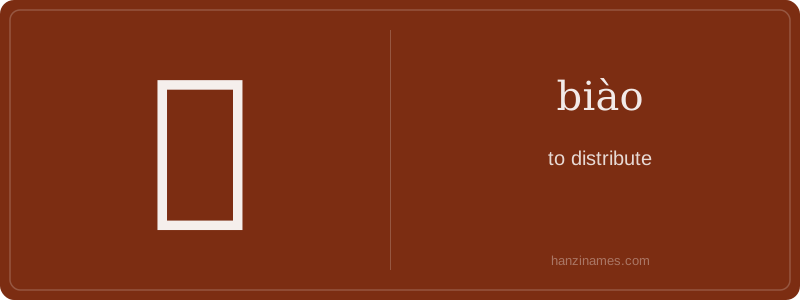
俵 is virtually unused in contemporary Mandarin speech or writing. It appears almost exclusively in historical Japanese loanwords or academic discussions of East Asian agrarian systems—e.g., in studies of Edo-period rice taxation (koku system), where 1 俵 equaled ~150 kg of rice. No major Chinese idiom, proverb, or modern phrase contains it. It is absent from all HSK word lists and mainstream dictionaries like the Xiàndài Hànyǔ Cídiǎn.
The character’s form is a clear semantic compound: 米 (rice) + 包 (to wrap/contain). This reflects its original Japanese function—a woven straw bag (*tawara*) used to hold and distribute standardized rice rations. While not found in oracle bone script, its design follows Tang-era Chinese character logic, adapted locally in Japan for bureaucratic clarity.
As a linguistic detective, I begin by noting that 俵 (biào) is not a native Chinese character in origin—it was created in Japan as a *kokuji* (national character), meaning it has no attestation in ancient Chinese texts like oracle bones or bronze inscriptions. Its earliest documented use appears in Japanese agricultural records from the Heian and Kamakura periods, where it denoted a standardized rice measure—and by extension, the act of distributing such measured portions.
The character’s structure reveals its functional logic: the left radical 米 (mǐ, 'rice') anchors its semantic field in grain-based economy, while the right component 包 (bāo, 'to wrap' or 'envelop') signals containment and allocation—suggesting 'a wrapped unit of rice for distribution.' This is not pictographic but ideographic synthesis, typical of later Japanese coinages designed for administrative precision.
Though absent from standard HSK lists and rarely used in modern Mandarin, 俵 survives in historical Sino-Japanese vocabulary and specialized contexts like classical poetry or archival documents referencing feudal land-tax systems. Its pronunciation biào reflects the *Sino-Japanese reading* (on'yomi), not a native Chinese phonetic development—confirming its Japanese genesis. Linguistic forensics thus conclude: this is a Japanese-made character adopted into Chinese lexicography only secondarily, not an ancient Chinese root.
Example Sentences
Common Compounds
Similar Characters — Don't Mix These Up
Your First Step into Chinese Culture: Get a Chinese Name
Every journey into Chinese begins with a name. Use our free Chinese name generator to create a meaningful, personalized Chinese name that fits you perfectly.
Get My Chinese Name →