俷
Character Story & Explanation
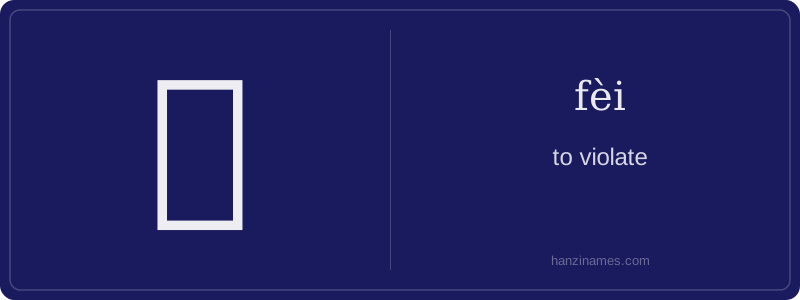
俷 is virtually absent from modern spoken and written Chinese. It appears only in pre-Qin and Han classical texts, scholarly annotations, and historical linguistics research—not in daily conversation, media, or education. There are no idioms (chengyu) containing 俷 in authoritative sources like the *Great Dictionary of Chinese Idioms* (《汉语成语大词典》). Its documented use is confined to rare citations in commentaries on the *Zuo Zhuan* and *Guliang Zhuan*, where it denotes violation of ritual propriety (礼) or moral mandate (德).
The character is composed of the 人 (rén, 'person') radical on the left and 費 (fèi, 'to expend; waste') on the right—a semantic-phonetic compound. While 費 provides pronunciation, its meaning reinforces 俷’s sense of costly, wasteful transgression. No oracle bone or bronze script forms survive; earliest attestation is in Han dynasty bamboo slips from Mawangdui (2nd c. BCE), confirming its archaic, literary status.
As an archaeologist sifting through layers of linguistic sediment, I find 俷 buried deep—not in oracle bones or bronze inscriptions, but in classical texts and legal commentaries. Its rarity suggests it was never a workhorse character like 道 or 人, but a precise tool: a lexical scalpel for denoting deliberate, morally charged violation—of rites, oaths, or cosmic order. It surfaces in Han dynasty exegetical works and Tang legal codes, always paired with weighty nouns: 'violation of filial duty', 'violation of ancestral covenant'.
This character carries the gravity of ritual rupture. Unlike common synonyms such as 违 (wéi), 俷 implies conscious, almost sacrilegious transgression—not mere failure to comply, but active defiance rooted in moral abandonment. Its phonetic component 費 (fèi, 'to expend') hints at cost: violating sacred norms isn’t passive; it consumes virtue and invites retribution. Early dictionaries like the *Shuōwén Jiězì* (121 CE) classify it under the 人 (rén, 'person') radical—emphasizing agency, not accident.
What’s striking is its near-total erasure from modern usage. No HSK list includes it; no contemporary newspaper employs it. Yet its spectral presence lingers in scholarly editions of *Zuo Zhuan* and imperial edicts, where it marks pivotal moments of ethical collapse—like Duke Ling of Jin’s 俷德 ('violation of virtue'), cited as justification for regicide. To encounter 俷 today is to hold a fossilized warning: language preserving the exact word for when a ruler breaks the Mandate of Heaven.
Example Sentences
Common Compounds
Similar Characters — Don't Mix These Up
Your First Step into Chinese Culture: Get a Chinese Name
Every journey into Chinese begins with a name. Use our free Chinese name generator to create a meaningful, personalized Chinese name that fits you perfectly.
Get My Chinese Name →