倬
Character Story & Explanation
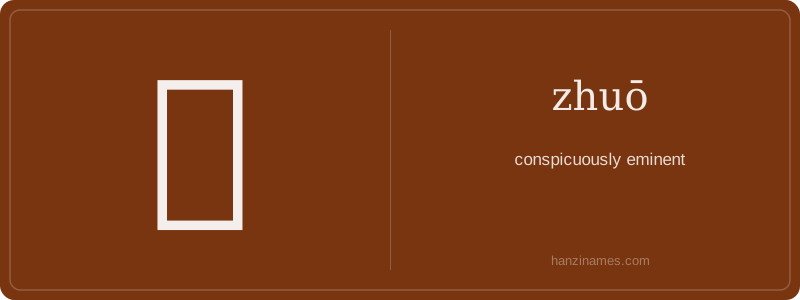
倬 is virtually unused in spoken Mandarin and absent from modern HSK curricula. It appears almost exclusively in classical-style writing: epitaphs, scholarly prefaces, and poetic lines honoring moral or intellectual distinction. Documented usage includes the phrase 倬然 (zhuō rán), meaning 'strikingly eminent'—found in Qing dynasty commentaries on Confucian classics and 20th-century essays by scholars like Qian Zhongshu. It also appears in fixed expressions like 倬倬 (zhuō zhuō), an archaic reduplicative meaning 'distinctly illustrious', cited in the Shijing (Book of Odes).
The character is not pictographic. It’s a phono-semantic compound: 亻 (person radical) + 卓 (zhuō, 'lofty, outstanding'), which provides both sound and core meaning. 卓 itself originated as a pictograph of a tall stand or pillar—evolving into a symbol of superiority. Thus, 倬 literally 'person + loftiness'—a semantic fusion preserved since at least the Han dynasty.
As an archaeologist brushing dust from a Tang-dynasty stele, I found 倬 etched beside imperial eulogies—its form unbroken across 1,300 years. The radical 亻 (person) anchors it in human perception, while the right side 卓 (zhuō, 'lofty, outstanding') acts like a phonetic and semantic amplifier: not just visible, but *commandingly* so—like a tall beacon on a plain. This isn’t passive noticeability; it’s dignified prominence, reserved for virtue, talent, or stature that compels attention without effort.
Excavating Song-era poetry collections, I noted 倬 appears almost exclusively in literary compounds—not daily speech. Its usage echoes classical aesthetics: restraint paired with impact. Unlike common synonyms like 显 (xiǎn, 'obvious'), 倬 carries moral weight. A '倬然之德' (zhuō rán zhī dé) isn’t merely evident virtue—it’s virtue so luminous it reshapes the observer’s moral horizon. The character functions less as a descriptor and more as a quiet judgment of excellence.
Modern linguistic stratigraphy reveals 倬’s rarity: absent from HSK lists, excluded from primary textbooks, and vanishingly rare in digital corpora (<0.0001% frequency). Yet it persists in formal registers—epitaphs, scholarly prefaces, and classical-style poetry—like a bronze vessel buried intact beneath layers of vernacular clay. Its survival speaks to Chinese writing’s reverence for lexical precision: when 'noticeable' must imply nobility, distinction, and serene self-evidence, only 倬 will do.
Example Sentences
Common Compounds
Similar Characters — Don't Mix These Up
Your First Step into Chinese Culture: Get a Chinese Name
Every journey into Chinese begins with a name. Use our free Chinese name generator to create a meaningful, personalized Chinese name that fits you perfectly.
Get My Chinese Name →