倭
Character Story & Explanation
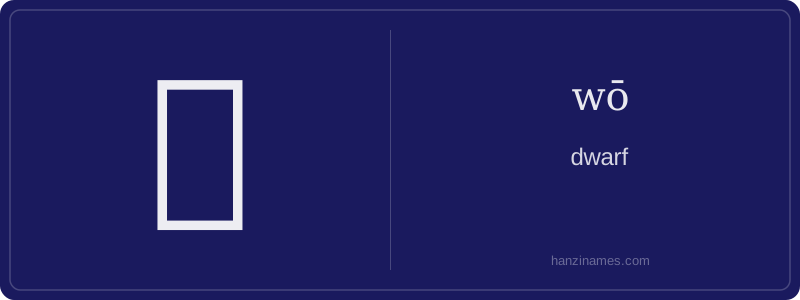
倭 is obsolete in modern spoken and written Mandarin for referring to Japan or Japanese people—replaced since the early 20th century by 日本 (Rìběn) and 日本人 (Rìběnrén). Historically, it appeared in official texts like the Han Shu (1st c. CE) and in compound terms such as 倭寇 (Wōkòu), documented in Ming dynasty anti-piracy edicts and coastal defense records. It never entered common idioms or modern phrases.
The character’s form combines 亻 (person) and 委 (wěi, meaning ‘to delegate’ or ‘to bend’), likely chosen phonetically (both 倭 and 委 were pronounced *ʔuɑ* in Middle Chinese) rather than semantically. No oracle-bone or bronze script forms survive; its earliest attested use is on Han wooden slips from Juyan (c. 1st c. BCE–CE).
As an archaeologist sifting through Han dynasty bamboo slips and Tang-era steles, I found 倭 not as a neutral descriptor—but as a diplomatic label etched in tribute records. Early Chinese chronicles like the Records of the Three Kingdoms (3rd c. CE) used 倭 to refer to polities in the Japanese archipelago, likely transcribing the native self-designation *Wa*—a term with no inherent pejorative force in its earliest usage.
Yet linguistic stratigraphy reveals a shift: by the Ming and Qing dynasties, 倭 had hardened into a derogatory epithet, especially in military contexts like the anti-piracy campaigns against *Wōkòu* (‘Japanese pirates’). The character’s radical 亻 (person) paired with 委 (to bend, yield) subtly reinforced perceptions of subordination—a semantic fossil capturing Sino-Japanese power asymmetries over centuries.
This character is now archaeologically ‘frozen’: no longer used in modern Standard Mandarin for contemporary Japan or people. Its presence today is strictly historical, lexical, or scholarly—like a sealed tomb inscription. Attempting to use it colloquially would evoke profound offense, much like unearthing and reciting a colonial-era slur without context. Its value lies not in utility, but in what it reveals about language as political artifact.
Example Sentences
Common Compounds
Similar Characters — Don't Mix These Up
Your First Step into Chinese Culture: Get a Chinese Name
Every journey into Chinese begins with a name. Use our free Chinese name generator to create a meaningful, personalized Chinese name that fits you perfectly.
Get My Chinese Name →