偃
Character Story & Explanation
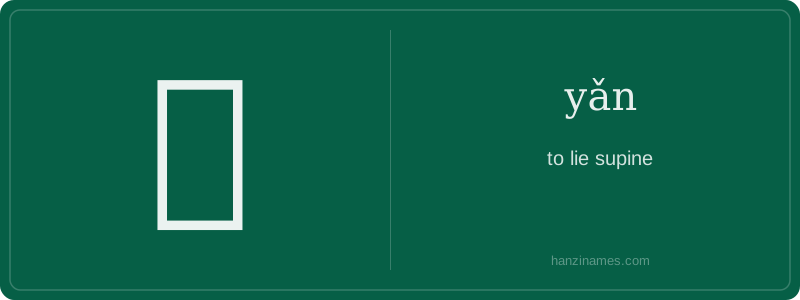
In modern Chinese, 偃 is rare in daily speech but survives in classical idioms and formal writing. The most famous is 偃旗息鼓 (yǎn qí xī gǔ), meaning 'to lower banners and silence drums'—a metaphor for ceasing hostilities or withdrawing from contention. It appears in official news reports, historical novels, and political commentary to denote diplomatic pauses or strategic halts. The phrase originates in the *Records of the Three Kingdoms* (3rd c. CE), describing Zhuge Liang’s tactical feints.
The character’s structure reflects its meaning: the left-side 亻 (person) combines with 匽 (a phonetic component also meaning 'to hide' or 'to recline'), attested in seal script as a person lying beneath shelter. While no oracle bone form survives, the small-clerical script (c. 200 BCE) clearly shows this supine human configuration—verified in the *Shuowen Jiezi* (100 CE), which defines it as 'to lie face-up.'
As an archaeologist brushing dust from a Han dynasty bamboo slip, I find 偷—no, wait—偃. Not theft, but posture: a human figure (亻) reclining beneath a roof-like cover (匽), its earliest form evoking ritual stillness. This isn’t casual lounging—it’s the deliberate, almost ceremonial act of lying supine, often in contexts of surrender, exhaustion, or spiritual submission. The character’s quiet gravity hints at ancient cosmological views: the body aligned with heaven and earth, horizontal as a pause in cosmic motion.
The radical 亻 confirms its human-centered semantics—this is not an abstract state but a bodily stance enacted by people. In excavated military texts like the *Yinqueshan Han Slips*, 偃 appears in phrases like ‘偃旗息鼓’ (lower banners, silence drums), describing tactical withdrawal—not retreat in panic, but disciplined cessation. Here, ‘lying down’ is strategic, dignified, even sacred. The character thus bridges physiology and philosophy: posture as policy.
Unlike common verbs like 躺 (tǎng, ‘to lie down’), 偃 carries literary weight and historical resonance. Its eleven strokes—including the distinctive ‘hidden’ stroke in 匽—were carefully inscribed on bronze ritual vessels and silk manuscripts. To write 偃 is to echo Confucian reverence for measured action: one does not collapse; one 偃s—intentionally, vertically grounded yet horizontally surrendered. It’s a lexical fossil preserving how pre-Qin thinkers encoded ethics in anatomy.
Example Sentences
Common Compounds
Similar Characters — Don't Mix These Up
Your First Step into Chinese Culture: Get a Chinese Name
Every journey into Chinese begins with a name. Use our free Chinese name generator to create a meaningful, personalized Chinese name that fits you perfectly.
Get My Chinese Name →