偌
Character Story & Explanation
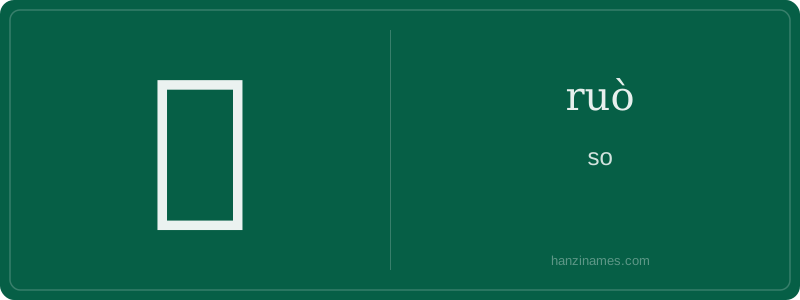
偌 is primarily used in formal, literary, or rhetorical contexts—not in casual speech. It appears in classical texts like the Book of Rites (Lǐjì) and modern literary works (e.g., Lu Xun’s essays) to intensify nouns: 偌大一座城 (‘so vast a city’) conveys awe or critique. Common compounds include 偌大 (ruòdà) and 偌多 (ruòduō), often found in journalism, historical narratives, and political rhetoric to underscore scale or irony.
偌 evolved from the ancient character 若 (ruò), meaning ‘if’ or ‘like’, which appears in oracle bone inscriptions as a pictograph of a woman with hands clasped in ritual submission. 偌 is a later phonosemantic compound: 亻 (person) + 若 (sound/semantic component), emphasizing human perception of magnitude. Its form stabilized during the Han dynasty, reflecting standardization of literary vocabulary.
偌 (ruò) is a classical Chinese adverb meaning 'so' or 'such', evoking scale, intensity, or emphasis—often with a tone of awe, irony, or rhetorical weight. Unlike neutral quantifiers like 很 (hěn), 偌 carries literary gravitas, hinting at the Confucian appreciation for measured, context-aware expression: magnitude isn’t stated plainly but implied through relational harmony—between speaker and subject, word and world.
This character reflects the Chinese worldview where language doesn’t merely describe reality but participates in its ordering. 偌 rarely stands alone; it anchors phrases like 偌大 (ruòdà, 'so vast') or 偌多 (ruòduō, 'so many'), inviting the listener to feel the weight of proportion—not just size, but significance. In classical thought, 'so much' implies moral or aesthetic resonance: a mountain isn’t merely large—it’s 偌大 because it commands reverence.
Its human radical (亻) subtly underscores that such judgments are inherently human-centered—not objective measurements, but embodied responses. The character thus embodies the Daoist-Confucian balance: acknowledging vastness while grounding it in human perspective. This mirrors the broader cultural orientation where meaning emerges not from abstraction, but from situated, relational awareness—a worldview where 'so' is never empty emphasis, but an ethical and perceptual anchor.
Example Sentences
Common Compounds
Similar Characters — Don't Mix These Up
Your First Step into Chinese Culture: Get a Chinese Name
Every journey into Chinese begins with a name. Use our free Chinese name generator to create a meaningful, personalized Chinese name that fits you perfectly.
Get My Chinese Name →