傀
Character Story & Explanation
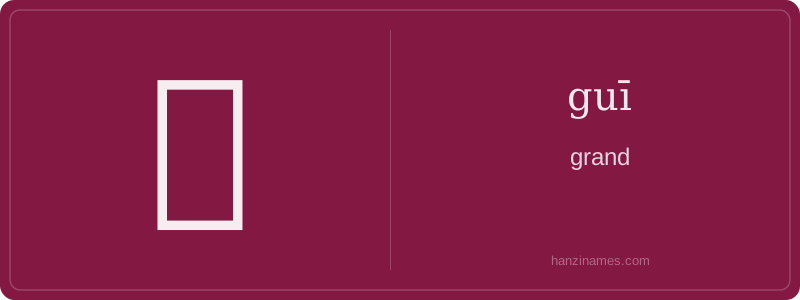
傀 is rarely used alone in modern Mandarin; its primary real-world presence is in the compound 傀儡 (guǐlěi), meaning 'puppet'—both literally (e.g., traditional string puppets in Fujian opera) and figuratively (e.g., 'a puppet ruler'). The term appears in historical records such as the *Book of Han*, referencing ceremonial effigies in imperial rites. Today, it's common in political discourse: 'political puppet' (政治傀儡) is a documented phrase in Chinese media and academic writing.
The character’s form combines 亻 (person radical) and 圭 (guī, a jade tablet symbolizing authority and ritual purity). 圭 was an actual ceremonial jade object used by Zhou dynasty nobles—linking 傀 etymologically to dignified, sanctioned representation, not mere artifice.
The character 傀 (guī) opens a window into the Chinese worldview where grandeur is not merely about size or power, but about *moral stature* and *ritual significance*. Historically, it described ceremonial figures—statues or puppets used in ancestral rites—imbued with symbolic weight rather than autonomy. This reflects a cultural understanding that true 'grandness' arises from role, reverence, and alignment with cosmic or social order, not individual agency.
In classical texts like the *Zuo Zhuan*, 傀 appears in contexts describing ritual effigies representing noble ancestors—objects of veneration, not control. Such usage reveals how early Chinese thought linked physical representation with ethical resonance: a 'grand' figure was one that embodied virtue, continuity, and duty, even if immobile or silent. Grandeur here is relational and performative, rooted in function within tradition.
Modern usage retains this layered dignity: while 傀儡 (guǐlěi) now means 'puppet'—often with negative connotations of manipulation—the root 傀 preserves its aura of solemn import. It reminds us that in Chinese cosmology, scale and significance are inseparable from context, intention, and moral resonance—not just appearance. To call something 傀 is to place it within a lineage of meaning far deeper than mere impressiveness.
Example Sentences
Common Compounds
Similar Characters — Don't Mix These Up
Your First Step into Chinese Culture: Get a Chinese Name
Every journey into Chinese begins with a name. Use our free Chinese name generator to create a meaningful, personalized Chinese name that fits you perfectly.
Get My Chinese Name →