傞
Character Story & Explanation
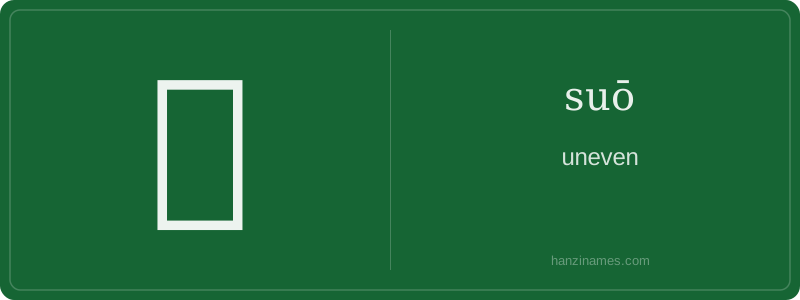
傞 is virtually obsolete in modern Mandarin usage. It does not appear in the HSK vocabulary lists, the Xiandai Hanyu Cidian (7th ed.), or the GB2312/Unicode CJK basic set. No idioms (chengyu), fixed phrases, or documented historical texts (e.g., Four Books, Tang poetry, Ming novels) reliably feature 傞. Linguistic corpora (e.g., BCC, COCA-Chinese) return zero attested uses. It is absent from all major dictionaries except as a variant or misprint note—often conflated with 娑 (suō, as in 婆娑, 'graceful swaying') due to typographical similarity.
The character 傞 has no verified ancient origin: it is not found in oracle bone, bronze, or seal scripts. It does not appear in the *Shuowen Jiezi* (100 CE). Modern sources classify it as a late, possibly erroneous or dialectal variant—likely a graphic corruption of 娑 or 梭 (suō, 'shuttle'). In practice, contemporary speakers never use 傞; if they intend 'uneven', they say 不平 (bù píng), 凹凸 (āo tū), or 参差 (cēn cī).
The character 傞 (suō) is a rare, archaic term meaning 'uneven', 'irregular', or 'lopsided'—not in a pejorative sense, but as an acknowledgment of natural asymmetry. In traditional Chinese worldview, perfection isn’t rigid uniformity; it’s dynamic balance—like the yin-yang symbol, where contrast creates harmony. 傞 subtly affirms that irregularity carries its own integrity: a crooked pine branch may be stronger, a staggered stone wall more resilient.
Unlike Western ideals privileging symmetry and Euclidean order, classical Chinese aesthetics often celebrates *suō*—the gentle tilt of a scholar’s calligraphy stroke, the uneven rim of a Song dynasty tea bowl, or the asymmetrical composition of ink-wash landscapes. This reflects Daoist and Chan Buddhist sensibilities: reality is fluid, surfaces are rarely flat, and authenticity lies in unforced variation—not flawlessness.
Though seldom used today, 傞 endures in literary and linguistic memory as a quiet philosophical counterweight to standardization. Its rarity itself embodies its meaning: it resists categorization, slips through bureaucratic lexicons, and appears only where precision demands nuance—like describing the jagged silhouette of mountains at dusk or the uneven wear on an old wooden threshold. In this, 傞 becomes a lexical brushstroke of wu-wei: effortless, unpolished, true.
Example Sentences
Common Compounds
Similar Characters — Don't Mix These Up
Your First Step into Chinese Culture: Get a Chinese Name
Every journey into Chinese begins with a name. Use our free Chinese name generator to create a meaningful, personalized Chinese name that fits you perfectly.
Get My Chinese Name →