傣
Character Story & Explanation
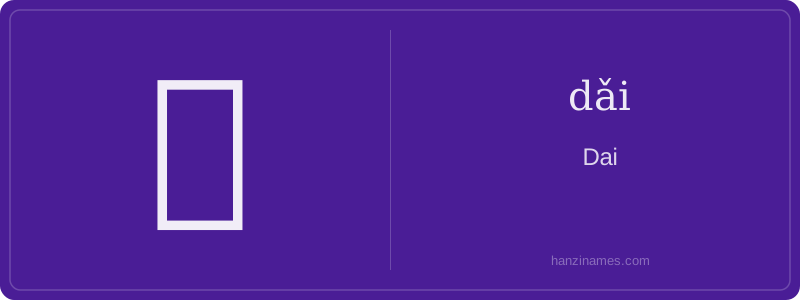
傣 is used almost exclusively as an ethnonym in official, academic, and cultural contexts in China—never as a standalone verb or adjective. It appears in government documents (e.g., ‘Dai Autonomous Prefecture’), school textbooks, and CCTV documentaries. There are no idioms or classical phrases containing 傣; it lacks literary or colloquial usage outside ethnic designation. Its earliest documented use in print is in the 1954 PRC Constitution, listing the ‘Dai nationality’ among 56 recognized groups.
The character has no ancient pictographic origin—it was newly formed in the 1950s using existing components. In daily life, Chinese speakers encounter it mainly on maps (e.g., Xishuangbanna Dai Autonomous Prefecture), museum signage, or when ordering ‘Dai-style sour soup’ (傣味酸汤) in Yunnan restaurants—always referencing culture or identity, never abstract meaning.
As a linguistic detective, I begin by examining 傣’s structure: a left-side 亻(radical for 'person') paired with 台 (tái, meaning 'platform' or 'terrace') on the right. This is a phonetic-semantic compound—亻 signals it’s an ethnic group (human-related), while 台 provides pronunciation (dǎi is a dialectal or historical variant of tái). The character was formally standardized in the 20th century to denote the Dai people, not derived from ancient scripts but created for modern ethnolinguistic precision.
The character does not appear in oracle bone, bronze, or seal scripts—it emerged post-1949 during China’s ethnic identification project. Prior to standardization, the Dai were variously written as 摆、歹, or even Tai (using Latin script). 傣 was deliberately selected to distinguish the Chinese-recognized ethnic minority from the broader Tai-speaking peoples of Southeast Asia, reflecting state-led nomenclature rather than organic evolution.
Its 12-stroke composition follows standard modern clerical order: two strokes for 亻 (piě + shù), then 10 strokes for 台 (starting with the top horizontal, then the vertical, etc.). Though visually simple, its political and cultural weight far exceeds its form—every stroke anchors it to national census categories, bilingual education policies, and UNESCO-recognized intangible heritage like the Dai Water-Splashing Festival.
Example Sentences
Common Compounds
Similar Characters — Don't Mix These Up
Your First Step into Chinese Culture: Get a Chinese Name
Every journey into Chinese begins with a name. Use our free Chinese name generator to create a meaningful, personalized Chinese name that fits you perfectly.
Get My Chinese Name →