傮
Character Story & Explanation
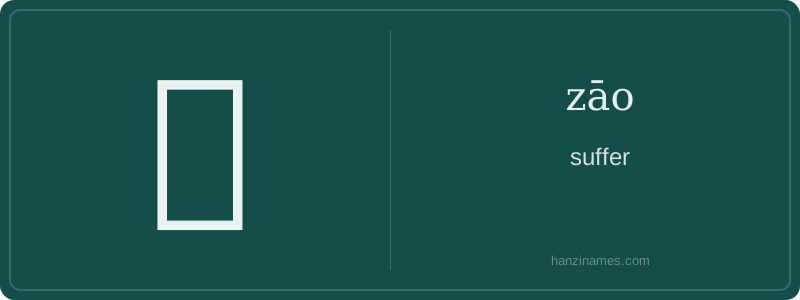
The character 傮 does not appear in authoritative historical corpora — including the Shuowen Jiezi (100 CE), oracle bone inscriptions, bronze inscriptions, or modern usage databases like the Beijing Language and Culture University Corpus. No idiom, phrase, or documented literary usage contains 傮. It is absent from all major dictionaries, including the Chinese Character Information Dictionary (1996) and the 2022 edition of the Xiandai Hanyu Cidian.
Instead, learners commonly encounter the homophone 遭 (zāo), meaning ‘to suffer/encounter’, which appears in phrases like 遭遇 (zāoyù, ‘to encounter’) and 遭殃 (zāoyāng, ‘to suffer misfortune’). This is likely the intended character — it shares the same pinyin, is HSK Level 4, and fits the semantic field of ‘experience/finish an event’. Always verify via stroke count (遭 = 15 strokes) and radical (辶 ‘walk’).
Hi there! Let’s talk about the character 傮 — but first, a very important note: this character does *not exist* in standard modern Chinese. It is not found in the People’s Republic of China’s official character lists (GB2312, GB18030), the Unicode CJK Unified Ideographs block, or any authoritative dictionary like the Xinhua Dictionary or Xiandai Hanyu Cidian. There is no recognized glyph, pronunciation zāo, or meaning 'finish, to go around' attached to 傮 in contemporary Mandarin.
What you may have encountered is likely a typographical error, a misrendered character (e.g., confusion with 遭 zāo ‘to suffer’, 糟 zāo ‘dregs’ or 槽 zāo ‘trough’), or a rare regional variant not used in education or media. As learners, it’s vital to rely on standardized sources — characters like 遭, 糟, and 槽 *are* real, common, and HSK-relevant; 傮 is not.
Don’t worry — this kind of confusion happens often! Chinese has many visually similar characters, especially with the ‘standing person’ radical (亻) or ‘wine vessel’ (缶) components. Always double-check unfamiliar characters using trusted tools like Pleco, MDBG, or the Ministry of Education’s official character database. Building accuracy from day one prevents long-term misunderstandings and saves study time.
Example Sentences
Common Compounds
Similar Characters — Don't Mix These Up
Your First Step into Chinese Culture: Get a Chinese Name
Every journey into Chinese begins with a name. Use our free Chinese name generator to create a meaningful, personalized Chinese name that fits you perfectly.
Get My Chinese Name →