傿
Character Story & Explanation
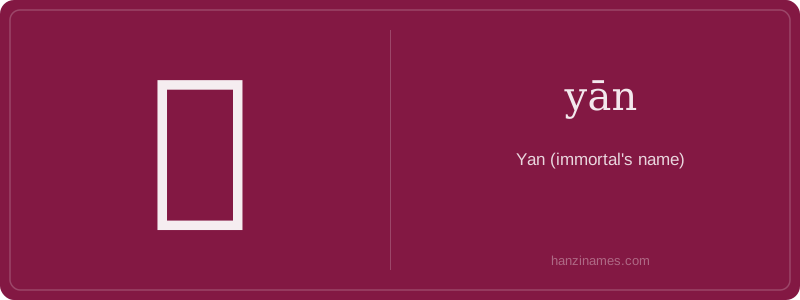
傿 is virtually unused in contemporary daily life. It appears almost exclusively in pre-modern Daoist biographies, local gazetteers, and scholarly editions of texts like the Liexian Zhuan (Biographies of Immortals). No modern idioms, internet slang, or common compounds contain 傿. It’s absent from all HSK word lists and does not appear in the 3,500 most frequently used Chinese characters. Even native speakers rarely encounter it outside academic or religious contexts.
The character is not pictographic—it evolved from seal script where 亻+焉 merged orthographically. 焉 itself originated as a compound of 火 (fire) and 止 (foot/base), later stylized beyond recognition. Today, 傿 survives only in historical anthologies, temple inscriptions honoring immortals, or as a rare surname in southern China (e.g., Fujian lineage records), making it a lexical fossil rather than a living word.
Our detective work begins with the radical 亻—'person'—a clear signal this character relates to a human or human-like figure. The right side, 焉, is both phonetic and semantic: it originally depicted smoke rising from a vessel (in ancient forms), later evolving into a grammatical particle meaning 'there' or 'thus'. In 傿, however, 焉 functions almost exclusively as a phonetic component, preserving the yān/yàn pronunciation while lending an air of antiquity and transcendence.
Historically, 傿 appears in early Daoist texts and hagiographies as a proper name—not a generic term for 'immortal', but specifically tied to legendary figures like 傿光 (Yān Guāng), a reclusive sage said to have lived during the Eastern Han dynasty. Its rarity in classical literature underscores its specialized use: not as vocabulary, but as a marker of elite spiritual identity, often appearing alongside titles like 真人 ('true person') or 仙 ('xian, immortal').
The dual pronunciation yān (first tone) and yàn (fourth tone) reflects historical tonal shifts and textual variants—yān dominates in personal names and Daoist lineages, while yàn appears in rare phonetic glosses or dialectal transcriptions. Unlike high-frequency characters, 傿 has no modern simplification; its form remains unchanged since the Kangxi Dictionary (1716), where it was classified under Radical 9 (亻) with 12 strokes—though modern count standardizes to 13 due to stroke-splitting conventions in printing fonts.
Example Sentences
Common Compounds
Similar Characters — Don't Mix These Up
Your First Step into Chinese Culture: Get a Chinese Name
Every journey into Chinese begins with a name. Use our free Chinese name generator to create a meaningful, personalized Chinese name that fits you perfectly.
Get My Chinese Name →