僖
Character Story & Explanation
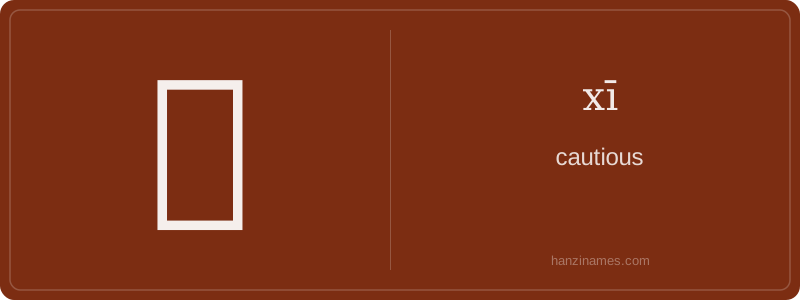
僖 appears almost exclusively in historical and ceremonial contexts — most notably in posthumous titles of Zhou dynasty rulers, such as 鲁僖公 (Lǔ Xī Gōng), Duke Xi of Lu (r. 659–627 BCE), recorded in the *Zuo Zhuan*. It’s also found in the *Shuowen Jiezi* (1st c. CE), China’s earliest dictionary, where it’s defined as 'cautious and reverent' (愼也). Today, it survives in surnames and scholarly discussions of classical texts — but never in daily speech or media.
The character’s structure combines 亻(person) + 喜 (xǐ, 'joy'), but this is not etymological — 喜 was borrowed phonetically (both share Old Chinese *s-qʰrəʔ). There’s no pictographic origin; it’s a phono-semantic compound. In modern life, Chinese people may encounter it only when studying ancient history, visiting temples with inscribed steles, or reading annotated classics.
Hi students! The character 僖 (xī) is a relatively rare but culturally rich character. It belongs to the 亻(person) radical, which tells us it relates to human qualities or behavior. Though it's not in the HSK syllabus (so no official HSK level), you’ll encounter it mainly in historical texts, names, and classical expressions — never in everyday spoken Mandarin like 'hello' or 'thank you'. Don’t confuse it with common characters like 喜 (xǐ, 'joy') — they look similar but carry very different meanings and tones.
Its core meaning is 'cautious', 'prudent', or 'reverent' — not fear-based caution, but thoughtful, respectful restraint, especially in ritual or moral contexts. In ancient usage, it often described virtuous conduct befitting a ruler or noble. The pronunciation xī is a first-tone flat sound — think of the word 'she' without the 'sh', held steadily: 'see' (but with clear 'x' aspiration, like 'si' in 'vision'). Practice saying it slowly while writing the strokes.
This character is not used independently in modern sentences. Instead, it appears in compound words, personal names (especially historical figures), and formal titles. For example, Duke Xi of Lu (鲁僖公) was a real Spring and Autumn period ruler whose posthumous title included 僖 — reflecting Confucian praise for his cautious governance and ritual propriety. So while you won’t text 僖 to friends, understanding it deepens your grasp of Chinese history, ethics, and how language encodes values.
Example Sentences
Common Compounds
Similar Characters — Don't Mix These Up
Your First Step into Chinese Culture: Get a Chinese Name
Every journey into Chinese begins with a name. Use our free Chinese name generator to create a meaningful, personalized Chinese name that fits you perfectly.
Get My Chinese Name →