僾
Character Story & Explanation
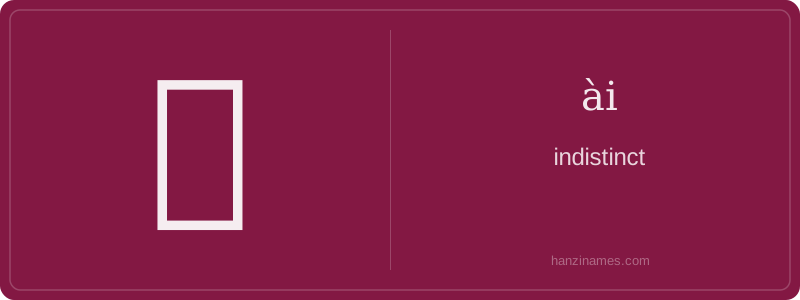
僾 is virtually absent from modern spoken Mandarin and does not appear in any HSK level, textbooks, or everyday digital communication. It survives only in classical poetry anthologies, scholarly editions of Tang–Song literature, and rare idiomatic compounds like 僾然 (àirán, 'faintly visible'). No major idiom or proverb features it. Contemporary usage is limited to literary translation, calligraphy demonstrations, or linguistic research—never in news, social media, or education curricula.
The character is a phono-semantic compound: left side 亻(person radical) signals human perception; right side 愛 (ài) provides pronunciation. Its earliest attestation is in the *Shuōwén Jiězì* (c. 121 CE), where Xu Shen defines it as 'faint appearance' (仿佛之貌). No oracle bone or bronze script forms exist—it emerged fully formed in clerical script during the Han dynasty, confirming its late, literary origin.
The Chinese character 僾 (ài) is a rare, literary term meaning 'indistinct', 'faint', or 'vague'—particularly describing something perceptible only dimly, such as a distant sound, a blurred silhouette, or a fleeting emotional impression. It conveys subtlety and sensory ambiguity, often evoking poetic or melancholic nuance. Unlike common synonyms like 模糊 (móhu, 'blurry') or 含糊 (hánhú, 'ambiguous'), 僾 carries classical resonance and appears almost exclusively in refined written contexts, not casual speech.
Etymologically, 僾 belongs to the 人 (rén, 'person') radical, suggesting human perception or subjective experience. Its right component, 愛 (ài, 'to love'), serves phonetically but also subtly reinforces emotional resonance—implying that what is 僾 is not merely physically faint, but emotionally evocative in its elusiveness. This duality makes it uniquely suited for classical poetry where sensory vagueness mirrors inner feeling.
In Western literary tradition, no single word maps precisely onto 僾, but English approximations include 'ghostly', 'ethereal', or 'half-remembered'. French has 'indistinct' (indistinct), German 'undeutlich', and Japanese '朧 (oboro)'—all emphasizing perceptual softness. Yet 僾 differs by implying *intentional perceptual delicacy*, not mere deficiency: it’s not that the thing is unclear, but that clarity would spoil its poetic essence—akin to how Keats’ 'negative capability' embraces uncertainty.
Example Sentences
Common Compounds
Similar Characters — Don't Mix These Up
Your First Step into Chinese Culture: Get a Chinese Name
Every journey into Chinese begins with a name. Use our free Chinese name generator to create a meaningful, personalized Chinese name that fits you perfectly.
Get My Chinese Name →