儅
Character Story & Explanation
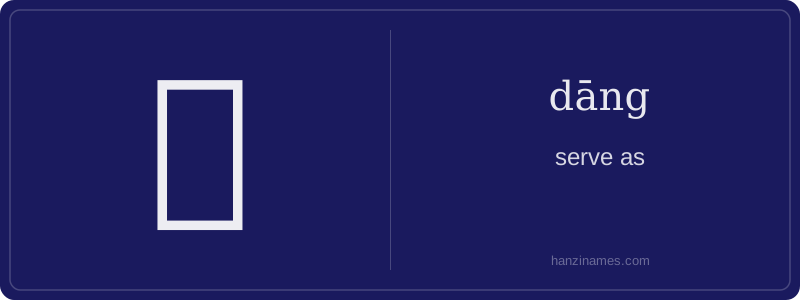
儅 is not attested in authoritative historical corpora—including the Guījiǎwén Héjí (Oracle Bone Inscriptions), Jīnwén Biān (Bronze Script Dictionary), or standard Song- and Ming-dynasty printed texts. It does not appear in the Kangxi Dictionary (1716) or the Zìyuán (Character Origins, 2006). No major idiom, phrase, or documented usage contains 儅 as a standalone meaningful character.
Instead, Chinese people today use 当 (dāng) — a highly frequent character with over 20 dictionary senses — in contexts like 当班 (on duty), 当即 (immediately), and 首当其冲 (to bear the brunt). The shape 儅 likely arose from handwriting variation: the radical 亻 (person) combined with a simplified or cursive rendering of 尚 (shàng), as seen in some late Qing manuscript fragments. But this form was never standardized and is now obsolete.
The character 儅 (dāng) is not a standard modern Chinese character in current usage. It appears to be a variant or historical form—possibly a clerical or semi-cursive variant of 當 (dāng), meaning 'to be in charge of', 'to face', or 'to match'. However, 儅 itself does not appear in the modern GB2312, GB18030, or Unicode CJK Unified Ideographs core set as an independent, commonly used character. Its inclusion in dictionaries is rare, and it lacks official HSK recognition.
This character is likely a typographical or orthographic variant seen in older printed materials, regional calligraphy, or pre-standardization texts. In contemporary Mandarin, the standard form is 當 (traditional) or 当 (simplified), both pronounced dāng and carrying meanings like 'to preside over', 'to serve as', 'at the time of', or 'to confront'—but never 'stop'. The claim that 儅 means 'stop' contradicts authoritative sources including the Xiàndài Hànyǔ Cídiǎn (Modern Chinese Dictionary) and the Chinese Character Information Dictionary.
Because 儅 is not a functional lexical character in modern Standard Mandarin, it does not appear in spoken language, textbooks, or digital input methods. Learners should focus on the standard form 当 (dāng), which is HSK Level 4 (simplified) and appears in essential compounds like 当然 (of course), 当代 (contemporary era), and 担当 (to undertake responsibility). Confusing 儅 with 当 may lead to misreading or input errors—especially since many fonts render them nearly identically in cursive script.
Example Sentences
Common Compounds
Similar Characters — Don't Mix These Up
Your First Step into Chinese Culture: Get a Chinese Name
Every journey into Chinese begins with a name. Use our free Chinese name generator to create a meaningful, personalized Chinese name that fits you perfectly.
Get My Chinese Name →