儆
Character Story & Explanation
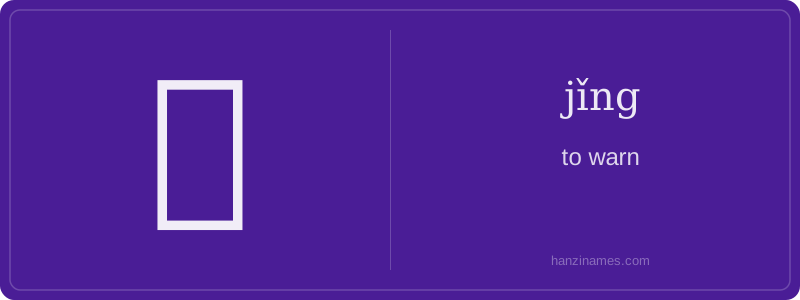
儆 is predominantly used in formal written contexts: government notices, judicial announcements, and classical or journalistic prose. A well-documented phrase is 杀一儆百 (shā yī jǐng bǎi), meaning 'kill one to warn a hundred'—a historically attested Legalist strategy cited in texts like the *Han Feizi* and applied during imperial dynastic reforms and modern anti-corruption campaigns. It appears in official media reporting on disciplinary actions by the CCP Central Commission for Discipline Inspection.
The character evolved from seal script (c. 3rd century BCE), combining 亻 (person radical) and 敬 (jìng, 'to respect/revere')—not a pictograph, but a semantic-phonetic compound. 敬 provides both sound and conceptual weight: warning arises from reverence for law/morality. Today, Chinese people encounter 儆 most often in headlines like '以儆效尤' (yǐ jǐng xiào yóu)—'to warn those who would imitate [the wrongdoing]'. It signals that punishment serves pedagogical, not merely punitive, ends.
儆 (jǐng) is a formal, literary character meaning 'to warn' or 'to serve as a warning', often implying a solemn, public, or exemplary admonition. Unlike casual English verbs like 'tell' or 'remind', 儿 carries moral gravity—used when consequences are serious and the warning is meant to deter others through visible accountability. It frequently appears in official, legal, or historical discourse, not everyday speech.
In Western contexts, its closest equivalents are phrases like 'making an example of someone' (e.g., Roman crucifixions along roads) or 'a cautionary tale' (e.g., Aesop’s fables). But while Western warnings often emphasize individual consequence, 儆 emphasizes collective deterrence—its purpose is societal order, rooted in Confucian and Legalist traditions where public punishment reinforces ethical norms.
This character reflects China’s long-standing emphasis on preventative governance: rather than waiting for wrongdoing, authorities issue warnings or enact symbolic punishments to forestall future violations. Its tone is authoritative, impersonal, and institutional—not emotional or interpersonal like 'caution' or 'beware'. That formality explains why it rarely appears in spoken Mandarin but remains vital in legal texts, historical records, and editorial language.
Example Sentences
Common Compounds
Similar Characters — Don't Mix These Up
Your First Step into Chinese Culture: Get a Chinese Name
Every journey into Chinese begins with a name. Use our free Chinese name generator to create a meaningful, personalized Chinese name that fits you perfectly.
Get My Chinese Name →