儇
Character Story & Explanation
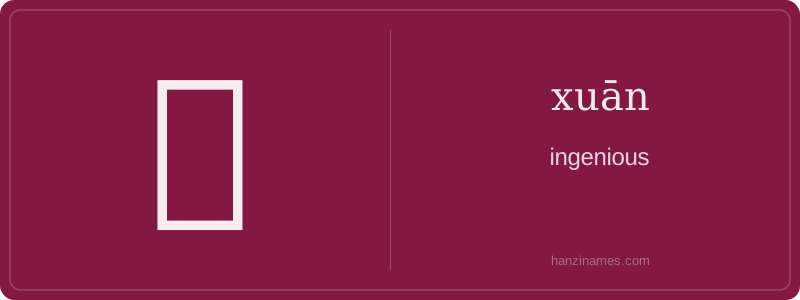
儇 appears most frequently in classical and literary contexts—not daily conversation—but remains actively used in formal writing, historical fiction, and poetic critique. It features in the idiom 儇薄 (xuān bó), meaning 'superficially clever but shallow', often used in Ming-Qing dynasty critiques of ostentatious scholars. The Shuōwén Jiězì (121 CE), China’s earliest systematic dictionary, defines 儇 as 'clever and quick' (慧而捷也), confirming its longstanding association with agile intellect. Modern writers like Lu Xun occasionally employed it to characterize characters with sharp, socially perceptive minds.
The character’s form combines 亻 (person) and 玄 (xuán, 'profound/mysterious'), both well-documented components. 玄 originally depicted interwoven threads or the deep black of dusk—symbolizing subtlety and depth—and has no pictographic sun/moon/tree origin. Its inclusion here reinforces that 儇’s cleverness is not flashy, but grounded in discernment of underlying truths.
儇 (xuān) embodies a distinctly Chinese ideal of intelligence—not raw intellect or scholarly rigor alone, but agile, socially attuned cleverness: quick-wittedness that harmonizes insight with grace and situational awareness. In classical thought, such ingenuity was never detached from virtue; it implied discernment in human relations, adaptability without deceit, and mental nimbleness aligned with moral clarity. This reflects the Confucian-Buddhist-Taoist convergence where wisdom is measured not just by what one knows, but how wisely one navigates complexity.
The character’s radical 亻 (person) signals its grounding in human conduct—this is not abstract brilliance, but *interpersonal* acuity. Its right side, 玄 (xuán), meaning 'profound', 'mysterious', or 'darkly subtle', adds a layer of depth: true ingenuity isn’t superficial cleverness, but insight that perceives underlying patterns, like the Taoist appreciation for hidden order beneath apparent chaos. Thus, 儇 suggests a mind both alert and reverent—sharp enough to see through illusion, yet humble enough to honor mystery.
In modern usage, 儇 carries gentle literary weight—rare in casual speech but cherished in poetry, essays, and refined discourse to praise someone’s elegant perceptiveness. It subtly critiques hollow wit: unlike the neutral ‘smart’ or pejorative ‘sly’, 儇 implies intelligence *tempered by refinement*. This mirrors the broader Chinese worldview where excellence emerges at the intersection of talent, cultivation, and ethical resonance—never in isolation. To call someone 儇 is to honor their mind *and* their manner.
Example Sentences
Common Compounds
Similar Characters — Don't Mix These Up
Your First Step into Chinese Culture: Get a Chinese Name
Every journey into Chinese begins with a name. Use our free Chinese name generator to create a meaningful, personalized Chinese name that fits you perfectly.
Get My Chinese Name →