俦
Character Story & Explanation
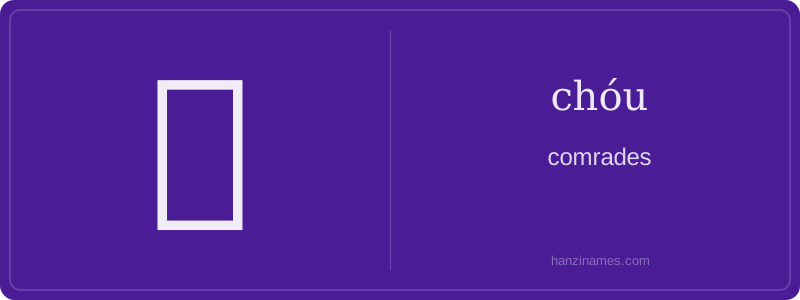
In contemporary China, 俦 appears primarily in formal written contexts: commemorative plaques at revolutionary sites (e.g., ‘革命同志之俦’ on the Yan’an Memorial Wall), classical-style eulogies, and academic essays on Confucian ethics. It’s featured in the idiom '俦类不群' (chóulèi bù qún, 'peers who stand apart') and frequently paired with words like '俊' (jùn, outstanding) or '英' (yīng, heroic). The People’s Daily has used it in editorials honoring exemplary Party members as '时代之俦' (chóu of the era).
The character is not pictographic—it evolved from seal script where the right component (寿) was borrowed for sound, not meaning. Its modern form reflects standardization in the 1956 Chinese Character Reform. Today, Chinese learners encounter it most often in HSK Advanced (Level 6) reading passages or classical poetry anthologies—not daily conversation—but its presence signals gravitas and shared purpose.
Chóu (俦) is a literary and formal character meaning 'comrades', 'peers', or 'equals'—emphasizing deep fellowship, shared ideals, or matched status. It rarely appears in casual speech but surfaces powerfully in classical poetry, political discourse, and solemn commemorations. Unlike the colloquial 'tóngzhì' (comrade), chóu carries a tone of mutual respect and moral alignment, often implying rarity and value—like finding one’s true intellectual or ideological counterpart.
This character evokes resonance across time: from Tang dynasty poets lamenting the scarcity of kindred spirits ('知音难觅,俦侣何寻'), to modern memorial inscriptions honoring fallen soldiers as 'revolutionary comrades'. Its radical 亻 (person) anchors it in human connection, while the right side (寿) originally signaled longevity—but here functions phonetically, lending the 'chóu' sound. Its elegance lies in restraint: just nine strokes, yet immense semantic weight.
Chóu appears almost exclusively in fixed, high-register phrases—never alone. You’ll find it in idioms like '俦类' (chóulèi, 'peers of the same caliber') or '俊俦' (jùnchóu, 'outstanding peers'). It’s favored in formal writing, official speeches, and elegies—not WeChat chats. Mastery of chóu signals not just vocabulary knowledge, but cultural literacy: recognizing when solemnity, reverence, or historical continuity demands this precise, resonant word for 'comrades'.
Example Sentences
Common Compounds
Similar Characters — Don't Mix These Up
Your First Step into Chinese Culture: Get a Chinese Name
Every journey into Chinese begins with a name. Use our free Chinese name generator to create a meaningful, personalized Chinese name that fits you perfectly.
Get My Chinese Name →